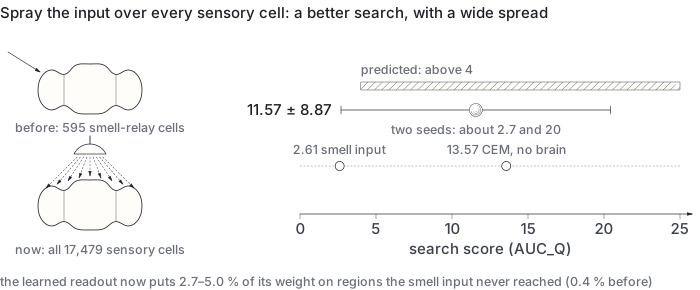
Does feeding the input to every sensory cell make the whole-brain search better?
Yes. The search score rose from 2.61 to 11.57, but its two seeds scored about 2.7 and 20, so the gain's size is uncertain.
In the log: Task 0, step 2b: the afferent broadcast as the brain's input
confirmedDate not stated in the log; it was written between the commit of 2026-09-16 19:06 and the first commit that contains it, 2026-09-19 08:35generator · fly brain0 predictions · 1 result paragraphEXPERIMENTS.md lines 10555–10582, lines 10776–10782, lines 10783–10785, lines 10817–10838
What E163 did and how it came out, drawn from this record and the files it names (book/assets/diagrams/exp/E163.svg).
Pre-registration
The pre-registration, as written
E163, seed 0 readout (arm still running). With the composition broadcast onto 17,479
afferent neurons instead of the 595 PNs, the learned readout after 799 lessons carries:
MBON 95.0%     LAL 4.28%     DNa 0.72%     DNa02 5.1e-4
E161 (olfactory input, same readout):  MBON 99.62%   LAL 0.37%   DNa 0.011%   DNa02 1.2e-5
LAL + DNa's share rose from 0.4% to 5.0% — twelve-fold — and DNa02 from 1e-5 to 5e-4.
E163 prediction 2 holds on seed 0: once the regions are driven, the delta rule puts weight
on them. Whether that weight helps is prediction 1 (AUC_Q above 2.61 and above 4.0), which
waits on the arm's second seed and its result row.
Results
EXPERIMENTS.md · line 10817
E163 result — confirmed, with the spread stated as the headline. Whole brain, the
composition broadcast onto 17,479 afferent neurons, learned LAL+DNa+MBON readout, E159's
protocol (200 x 4 x 2, no novelty):
Prediction 1 confirmed: 11.6 is above 2.61 and above 4.0 — x4.4 on AUC_Q, x4 on finds,
21 meV/atom deeper. The error bar is the honest part: two seeds at roughly 2.7 and 20, so
one seed matched E159 and the other quadrupled it. The mean is not a fluke of averaging —
both seeds are at or above E159 — but the size of the gain is not yet a number; it is a
range, and more seeds are the only way to narrow it. Prediction 2 confirmed on both seeds:
LAL + DNa share 5.0% and 2.7% against 0.4% under olfactory input; DNa02 5e-4 and 7e-4.
Prediction 3 stands as stated: the control is E159's whole-brain arm, not the subset.
With E161 and E163 together the story is now one sentence: the whole brain was silent
because its input reached 2.7% of it, and once the sensory surface is driven the learned
readout uses the regions the olfactory input never reached. This is the first result in
which the whole brain beats every previous fly arm, and the first time "use the whole head"
has a number attached that is not a deficit.
The full record
This entry is written in 4 separate places in the log, shown here in log order.
EXPERIMENTS.md · lines 10555–10582
E163 — Task 0, step 2b: the afferent broadcast as the brain's input
E157 measured the current olfactory entry engaging 2.7% of the brain and never reaching
DNa02, and the FlyGM construction — one low-dimensional code broadcast to the whole
afferent class — engaging 25% and firing 376 descending neurons in every family. E159 then
showed that reading LAL + DNa with a learned readout lifts the whole brain from 0.15 to
2.61 AUC_Q even under the olfactory input. Step 2b changes the input: the composition is
projected by a fixed random map onto all 17,479 afferent neurons (ORN, JO, LC, MeTu, OCG,
lamina) instead of onto the 595 PNs through the channel code. Readout, plastic site and
reward stay as in E159. FlyGM's encoder is trained; this first version is a fixed random
projection, the reservoir choice, and that difference is named so it is not mistaken for
the paper's.
Predicted, whole brain, E159's protocol (200 x 4 x 2, no novelty):
AUC_Q above E159's 2.61 and above 4.0 — a quarter of the brain now feeds a readout
already shown to work on 2.7% of it.
The learned readout's weight share on LAL + DNa exceeds what E161 measures under
olfactory input, since those populations are now driven.
The mushroom-body asset cannot run this encoder (it has no afferent class beyond
PNs), so the control is E159's whole-brain arm, not the subset — stated so the comparison
is not misread as whole-vs-subset.
Falsified if AUC_Q is at or below 2.61 — then engaging more of the brain adds nothing a
readout can use, the fixed random projection is the suspect (FlyGM's is trained), and the
next step is a trained encoder, not a bigger one. Falsified downward past E145's 0.15 if
the broadcast destroys the olfactory code the KC→MBON plasticity depends on — a sparsity
calibration failure, which the KC active fraction will show directly.
EXPERIMENTS.md · lines 10776–10782
E163, seed 0 readout (arm still running). With the composition broadcast onto 17,479
afferent neurons instead of the 595 PNs, the learned readout after 799 lessons carries:
MBON 95.0%     LAL 4.28%     DNa 0.72%     DNa02 5.1e-4
E161 (olfactory input, same readout):  MBON 99.62%   LAL 0.37%   DNa 0.011%   DNa02 1.2e-5
LAL + DNa's share rose from 0.4% to 5.0% — twelve-fold — and DNa02 from 1e-5 to 5e-4.
EXPERIMENTS.md · lines 10783–10785
E163 prediction 2 holds on seed 0: once the regions are driven, the delta rule puts weight
on them. Whether that weight helps is prediction 1 (AUC_Q above 2.61 and above 4.0), which
waits on the arm's second seed and its result row.
EXPERIMENTS.md · lines 10817–10838
E163 result — confirmed, with the spread stated as the headline. Whole brain, the
composition broadcast onto 17,479 afferent neurons, learned LAL+DNa+MBON readout, E159's
protocol (200 x 4 x 2, no novelty):
Prediction 1 confirmed: 11.6 is above 2.61 and above 4.0 — x4.4 on AUC_Q, x4 on finds,
21 meV/atom deeper. The error bar is the honest part: two seeds at roughly 2.7 and 20, so
one seed matched E159 and the other quadrupled it. The mean is not a fluke of averaging —
both seeds are at or above E159 — but the size of the gain is not yet a number; it is a
range, and more seeds are the only way to narrow it. Prediction 2 confirmed on both seeds:
LAL + DNa share 5.0% and 2.7% against 0.4% under olfactory input; DNa02 5e-4 and 7e-4.
Prediction 3 stands as stated: the control is E159's whole-brain arm, not the subset.
With E161 and E163 together the story is now one sentence: the whole brain was silent
because its input reached 2.7% of it, and once the sensory surface is driven the learned
readout uses the regions the olfactory input never reached. This is the first result in
which the whole brain beats every previous fly arm, and the first time "use the whole head"
has a number attached that is not a deficit.
Related entries
E157 — How much input does the brain need? Active fraction against sensory drive
E159 — Task 0, step 2: read the brain at LAL + DNa, not only at the 97 MBONs
E161 — Where the learned readout puts its weight (E159's unmeasured prediction 2)
E145 — Does the whole brain help? One change from the baseline.
E136 — The fly has not been used, and nothing found so far is new