Does a second learning site in the brain's navigation centre change the search?
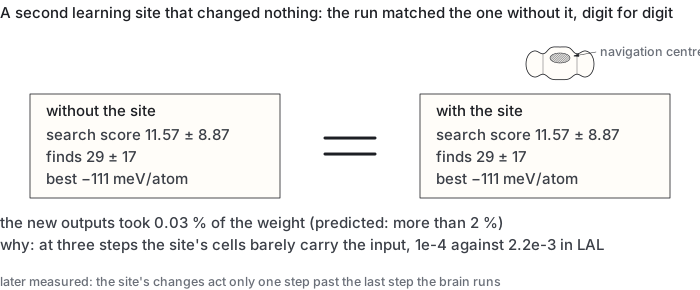
No. The run matched the one without it to every digit; the site's updates never reached anything the readout sees.
In the log: Task 0, step 3: a second plastic site, in the fan-shaped body
falsifiedDate not stated in the log; it was written between the commit of 2026-09-16 19:06 and the first commit that contains it, 2026-09-19 08:35rung 1 · ordering1 prediction · 1 result paragraphEXPERIMENTS.md lines 10789–10813, line 10815, lines 10862–10863, lines 10865–10869, lines 10910–10925, lines 10927–10945
What E166 did and how it came out, drawn from this record and the files it names (book/assets/diagrams/exp/E166.svg).
Pre-registration
(50)
added to the readout` — and the full run started from it.
no verdict written against it
The pre-registration, as written
E166 gate (build only, run queued): 255 passed, 2 skipped, 263 warnings in 820.58s (0:13:40) — tests/test_plastic_site.py adds 3.
E166: smoke passed — site: FB->hDelta/vDelta (602->619) gated by 20 FB dopamine cells; PFL (50) added to the readout — and the full run started from it.
E166 interim (seed 0 of 2, seed 1 running). Readout share after 799 lessons: LAL 4.28%,
DNa 0.72%, MBON 94.97%, PFL 0.03%. Prediction "PFL > 2%" not met; the stated
falsification bar "< 0.5%" is met on seed 0. The FB site is learning (it is taught on
every proposal with an ordering verdict) but the readout does not come to rely on PFL. Final
verdict waits for seed 1 and the AUC_Q/finds line.
E166 diagnosis (E168 measurement, runs/e168_fb_state.json). Mean |pre| per population
under the broadcast head, four random compositions:
The prediction "exactly 0" is falsified in its letter: the FB is not silent, it is
nearly silent — 13% of its cells at 1e-4. The substance stands: the eligibility at the
FB is 20–40× smaller than at LAL or DN, so a lesson with lr 0.1 and a standardised error of
order one moves an FB→hΔ/vΔ synapse by ~1e-5, and E166's 799 lessons could not move the
walk out of E163's trajectory. The FB site is inert on this head — not because the rule is
wrong but because the broadcast does not reach the fan-shaped body in three steps. This is
E157's question again: the whole brain is driven only as deep as the recurrence carries the
input, and the central complex sits below that depth. Branch opened: either more
recurrent steps (the FB is ≥4 synapses from the afferents) or an input that reaches it
(compass_input is already in the afferent set and still leaves ring cells at 1.6e-6) —
that is a measured statement about how much input the head needs, and it is the next
experiment, not tonight's.
Results
EXPERIMENTS.md · line 10910
E166 result — a null, and not the kind the prediction was about. Whole brain, broadcast
input, learned readout, plus the FB→hΔ/vΔ dopamine-gated site: AUC_Q 11.57 ± 8.87, 29 ± 17
finds, −111 meV — identical to E163 to every digit, and the seed-1 readout dump is E163's
(LAL 2.361%, DNa 0.383%, 799 lessons). PFL share 0.03% / 0.008%: the "< 0.5%" falsification
bar is met on both seeds, but the reason is not that the readout ignored PFL — it is that
the site changed nothing at all. Two seeded runs cannot coincide otherwise. The site was
taught (E167's smoke shows fb lessons arriving: 1 of 4 verifications carried an ordering
verdict), so its updates were exact zeros. The only zero in the rule is the eligibility,
cache["pre"] at the FB source cells.
Prediction for the diagnosis, written before it runs: under the afferent broadcast with
three recurrent steps, the FB cells' pre-state is exactly 0 (they sit deeper than three
synapses from any afferent), while LAL and DN carry non-zero state (E167's smoke already
shows their gains varying: step 0.026–0.075, patience 3.2–8.9). If FB is non-zero, this
explanation is wrong and the null needs another cause (the readout's PFL slice, or an
operator that is never rebuilt) — that branch is opened and stated as such.
The full record
This entry is written in 6 separate places in the log, shown here in log order.
EXPERIMENTS.md · lines 10789–10813
E166 — Task 0, step 3: a second plastic site, in the fan-shaped body
The mushroom body is the fly's fast associative learner; the fan-shaped body (FB) is its
navigation centre, where dopaminergic tangential cells shape hΔ/vΔ and the PFL steering
output (E156: FB 602, hΔ 189, vΔ 430, PFL 50; PFL is fed 35% by FB; 20 FB dopamine cells).
Every lesson so far has landed on one site, KC→MBON. Step 3 adds a second: rung-1
verdicts — the ordering temperature's margin to the window — delivered as FB-tangential
dopamine, gating plasticity at the synapses those cells innervate (FB → hΔ/vΔ → PFL), with
PFL added to the readout. The rule is the same three-factor rule as KC→MBON, selected by
transmitter and family from Atlas, not by name.
Predicted, when it runs (E159's protocol, broadcast input, both plastic sites):
Rung-1 verdicts move PFL: the learned readout's share on PFL is above 2% after two
hundred rounds — a site that receives its own reward takes weight, as LAL did in E163.
The two sites do not fight: the KC→MBON site's contribution (share on MBON, and the
swarm's ladder-p with only that site on) is within 20% of its E163 value.
AUC_Q does not fall below E163's, and rises if rung-1 margins carry information the
rung-0 reward does not — which E142 says they do (the gate under-reports ordering).
Falsified if PFL takes under 0.5% of |w| after two hundred rounds — then either the FB
dopamine cells do not reach PFL in this asset's graph at the depth the recurrence runs
(three steps), or rung-1 verdicts are too sparse (one per verified proposal) to teach a site
that only sees them; the E156 edge counts say the path exists, so sparsity would be the
suspect and the repair a rung-1 verdict on every proposal, not only the verified ones.
EXPERIMENTS.md · line 10815
E166 gate (build only, run queued): 255 passed, 2 skipped, 263 warnings in 820.58s (0:13:40) — tests/test_plastic_site.py adds 3.
EXPERIMENTS.md · lines 10862–10863
E166: smoke passed — site: FB->hDelta/vDelta (602->619) gated by 20 FB dopamine cells; PFL (50) added to the readout — and the full run started from it.
EXPERIMENTS.md · lines 10865–10869
E166 interim (seed 0 of 2, seed 1 running). Readout share after 799 lessons: LAL 4.28%,
DNa 0.72%, MBON 94.97%, PFL 0.03%. Prediction "PFL > 2%" not met; the stated
falsification bar "< 0.5%" is met on seed 0. The FB site is learning (it is taught on
every proposal with an ordering verdict) but the readout does not come to rely on PFL. Final
verdict waits for seed 1 and the AUC_Q/finds line.
EXPERIMENTS.md · lines 10910–10925
E166 result — a null, and not the kind the prediction was about. Whole brain, broadcast
input, learned readout, plus the FB→hΔ/vΔ dopamine-gated site: AUC_Q 11.57 ± 8.87, 29 ± 17
finds, −111 meV — identical to E163 to every digit, and the seed-1 readout dump is E163's
(LAL 2.361%, DNa 0.383%, 799 lessons). PFL share 0.03% / 0.008%: the "< 0.5%" falsification
bar is met on both seeds, but the reason is not that the readout ignored PFL — it is that
the site changed nothing at all. Two seeded runs cannot coincide otherwise. The site was
taught (E167's smoke shows fb lessons arriving: 1 of 4 verifications carried an ordering
verdict), so its updates were exact zeros. The only zero in the rule is the eligibility,
cache["pre"] at the FB source cells.
Prediction for the diagnosis, written before it runs: under the afferent broadcast with
three recurrent steps, the FB cells' pre-state is exactly 0 (they sit deeper than three
synapses from any afferent), while LAL and DN carry non-zero state (E167's smoke already
shows their gains varying: step 0.026–0.075, patience 3.2–8.9). If FB is non-zero, this
explanation is wrong and the null needs another cause (the readout's PFL slice, or an
operator that is never rebuilt) — that branch is opened and stated as such.
EXPERIMENTS.md · lines 10927–10945
E166 diagnosis (E168 measurement, runs/e168_fb_state.json). Mean |pre| per population
under the broadcast head, four random compositions:
The prediction "exactly 0" is falsified in its letter: the FB is not silent, it is
nearly silent — 13% of its cells at 1e-4. The substance stands: the eligibility at the
FB is 20–40× smaller than at LAL or DN, so a lesson with lr 0.1 and a standardised error of
order one moves an FB→hΔ/vΔ synapse by ~1e-5, and E166's 799 lessons could not move the
walk out of E163's trajectory. The FB site is inert on this head — not because the rule is
wrong but because the broadcast does not reach the fan-shaped body in three steps. This is
E157's question again: the whole brain is driven only as deep as the recurrence carries the
input, and the central complex sits below that depth. Branch opened: either more
recurrent steps (the FB is ≥4 synapses from the afferents) or an input that reaches it
(compass_input is already in the afferent set and still leaves ring cells at 1.6e-6) —
that is a measured statement about how much input the head needs, and it is the next
experiment, not tonight's.
Related entries
E156 — What the whole brain contains, and where the mushroom body's output actually goes
E159 — Task 0, step 2: read the brain at LAL + DNa, not only at the 97 MBONs
E163 — Task 0, step 2b: the afferent broadcast as the brain's input
E142 — E99 certified the ordering gate at equiatomic from data taken off equiatomic
E167 — octopamine gain and serotonin persistence read from the head (task 0 step 4)
E168 — named in the log, no entry of its own
E157 — How much input does the brain need? Active fraction against sensory drive