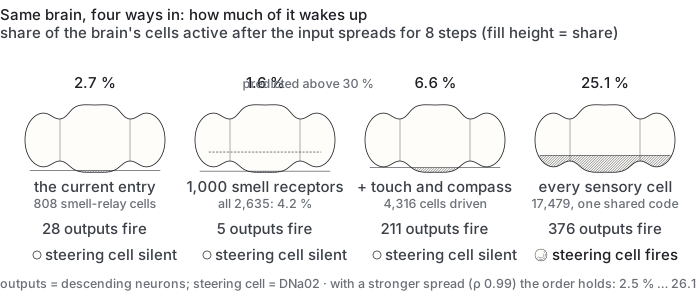
Does feeding every sensory cell wake more of the fly brain than smell alone?
Yes. Every sensory cell woke 25.1 % of the brain and reached the steering cell; smell alone woke at most 4.2 %.
In the log: How much input does the brain need? Active fraction against sensory drive
mixedDate not stated in the log; it was written between the commit of 2026-09-16 19:06 and the first commit that contains it, 2026-09-19 08:35rung 1 · ordering0 predictions · 2 result paragraphsEXPERIMENTS.md lines 10148–10184, lines 10186–10214, lines 10296–10333, lines 10335–10339
What E157 did and how it came out, drawn from this record and the files it names (book/assets/diagrams/exp/E157.svg).
Pre-registration
The pre-registration, as written
E157 addendum, before the run — three papers settle the encoder question and the design.
FlyGM (arXiv:2602.17997) does not assign features to neurons. Its observation — 741-d for
walking, 104-d for flight — is compressed to a 32-d code and broadcast to every afferent
neuron through a trainable gate; efferent = FlyWire's output flow class, decoded by an MLP;
each neuron carries a trainable descriptor, one shared update MLP; imitation from an MLP
expert then PPO; functional segregation into sensory / central / motor emerged inside.
"How much input the fly needs" is therefore not a count of driven neurons: it is a low-d
code reaching the whole afferent class, with the connectome doing the expansion.
Lappalainen et al. (Nature 634, 1132, 2024): 45,669 neurons, 1,513,231 connections,
734 free parameters — time constant and resting potential per cell type (65 each), one
unitary synapse strength per type pair (604) — task-optimized on optic flow with threshold-
linear differentiable dynamics; matched 26 studies. Per-type parameters suffice, and the
strategy works best when connectivity is sparse, which it is here.
Costi, Hadjiivanov, Dold, Hale & Izzo (Biomimetics 10, 341, 2025): the entire fly
connectome as a reservoir with a trained readout is markedly more overfitting-resilient than
standard reservoirs and reaches under 2% error at lower regularisation; both the topology
and the synaptic weights contribute (Morra & Daley 2022: 100x lower variance).
Design, revised: encoder = FlyGM-style broadcast of a ~32-d code (composition + ladder
state) onto the whole afferent class; dynamics = signed connectome operator with per-type
trainable gain and time constant (Lappalainen); readout = trained linear map over all
neurons or all descending neurons (Costi); learning = the ladder's reward through policy
gradient on the per-type parameters and the readout, plus three-factor plasticity at the
modulator targets. E157 adds encoding D — broadcast to the full afferent class — and the
prediction for it: the largest active fraction of all encodings, and DNs firing in every
family. Predictions 1-4 stand.
Results
EXPERIMENTS.md · line 10296
E157 result — how much input the brain needs, measured. Rate-level Shiu propagation on
the whole asset, spectral radius 3,749, g = 2.4e-4 (rho 0.9), 8 steps, unit drive on the
chosen neurons, active = above 1% of the largest driven rate.
encoding                  driven   active   outside MB   DNs active   DNa02   DN families
pn (current model)           808     2.7%       1.4%          28       no     7
orn:100                      100     0.3%       0.2%           1       no     1
orn:300                      300     0.5%       0.4%           2       no     1
orn:1000                   1,000     1.6%       1.2%           5       no     2
orn:all                    2,635     4.2%       2.9%           8       no     4
multi:100  (+JO +MeTu)     1,781     2.7%       2.7%         203       no     9
multi:1000                 2,681     4.0%       3.7%         206       no    10
multi:all                  4,316     6.6%       5.4%         211       no    10
afferent:all (broadcast)  17,479    25.1%      24.6%         376      YES    all
Prediction 1 confirmed: the current entry point engages 2.7% of the brain.
Prediction 2 falsified: olfaction is monotone in k but reaches 1.6% at a thousand
receptors and 4.2% with every one of them — nowhere near 30%. The olfactory pathway cannot
engage this brain, however hard it is driven; it is a narrow channel into the mushroom body
and the lateral horn and little else. Prediction 3 falsified on its named cell: JO + MeTu
raise descending activity from 8 to ~210 neurons — mechanosensation reaches DNs in one hop,
exactly as E156's edge counts said — but DNa02 does not fire under any olfactory-plus
encoding. Prediction 4 not assessable: no knee, at a level that does not matter.
Encoding D confirmed on both counts: driving the whole afferent class engages a quarter
of the brain, fires 376 descending neurons in every family, and is the only encoding that
reaches DNa02.
The answer. "How much input the fly needs" is not a number of olfactory neurons. It is
the sensory surface: the FlyGM construction — one low-dimensional code broadcast to every
afferent neuron through a gate — is the encoder, and the current 12-channel olfactory entry
is why 97% of the brain was silent. Task 0 step 2's input side is decided.
Caveat, pre-registered before the check: the absolute fractions depend on the recurrent
gain; at rho 0.9 the network is well sub-critical and 8 steps is shallow. The claim is the
ordering pn < orn < multi < afferent and DNa02 reachable only by the broadcast. Predicted
at rho 0.99: the ordering holds, the fractions rise by less than a factor of three, and
DNa02 still fires only under afferent:all. Falsified if olfaction alone reaches DNa02 at
rho 0.99, which would make the gain, not the encoder, the lever.
EXPERIMENTS.md · line 10335
E157 rho check — confirmed. At rho 0.99 (g = 2.6e-4 against 2.4e-4): pn 2.5%, orn:all
4.6%, multi:all 7.1%, afferent:all 26.1%; DN counts 25 / 10 / 217 / 391; DNa02 fires only
under the broadcast, as before. The ordering holds, every fraction moved by less than 10%
— well inside the "less than a factor of three" I allowed — and olfaction alone still does
not reach the steering neuron. The recurrent gain is not the lever. The encoder is.
The full record
This entry is written in 4 separate places in the log, shown here in log order.
EXPERIMENTS.md · lines 10148–10184
E157 — How much input does the brain need? Active fraction against sensory drive
The operator's directive is that the whole head learns and forms its own latent states, and
that how much of it engages depends on how much input it is given. Before any learning rule
is wired brain-wide, that dependence has to be measured, because it decides the encoder.
Model. Shiu et al. (Nature 2024) propagate activity through the whole connectome with
weights = synapse count x transmitter sign and one free gain, driving sparse sensory
populations, and predict descending-neuron output at 91%. This uses the same construction
at rate level rather than spike level: h_{t+1} = relu(g W_signed h_t + drive), W_signed
from the asset's contacts and the source neuron's transmitter (acetylcholine +, GABA /
glutamate / histamine -, modulators 0 for this purpose), g set so the largest eigenvalue is
below one, drive on the chosen sensory neurons only, 8 steps. A neuron is "active" if its
rate exceeds 1% of the maximum driven rate; a DN "fires" if active. Nothing here learns.
Sensory encodings compared, same composition, same gain:
A   the current model's input: 12 channels onto the 595 PNs (what MushroomBody does)
B   k olfactory receptor neurons (ORN, 2,635 total), k = 100, 300, 1,000, all
C   B plus mechanosensory JO (672) and compass input MeTu (1,009) carrying ladder state
Predicted:
Under A, fewer than 5% of the 164,506 neurons are ever active and the DNs that fire
are those two hops from the mushroom body only.
Active fraction rises monotonically with k under B, and at k = 1,000 exceeds 30%.
Under C, DNs fire in every descending family (DNa, DNb, DNd, DNg, DNp), including
DNa02, which under A never fires.
The curve saturates: doubling k past ~1,000 adds less than 5% more active neurons —
the brain's capacity to be engaged by sensory drive has a knee, and that knee is the
input size the encoder must reach.
Falsified if the active fraction under A is already above 20% — then the brain was
engaged all along and the earlier "loaded, not used" reading was about the readout alone,
not the dynamics; or if the curve under B is flat in k, which would mean propagation is
governed by the recurrent gain and not by how many inputs are driven, and the encoder is not
the lever.
EXPERIMENTS.md · lines 10186–10214
E157 addendum, before the run — three papers settle the encoder question and the design.
FlyGM (arXiv:2602.17997) does not assign features to neurons. Its observation — 741-d for
walking, 104-d for flight — is compressed to a 32-d code and broadcast to every afferent
neuron through a trainable gate; efferent = FlyWire's output flow class, decoded by an MLP;
each neuron carries a trainable descriptor, one shared update MLP; imitation from an MLP
expert then PPO; functional segregation into sensory / central / motor emerged inside.
"How much input the fly needs" is therefore not a count of driven neurons: it is a low-d
code reaching the whole afferent class, with the connectome doing the expansion.
Lappalainen et al. (Nature 634, 1132, 2024): 45,669 neurons, 1,513,231 connections,
734 free parameters — time constant and resting potential per cell type (65 each), one
unitary synapse strength per type pair (604) — task-optimized on optic flow with threshold-
linear differentiable dynamics; matched 26 studies. Per-type parameters suffice, and the
strategy works best when connectivity is sparse, which it is here.
Costi, Hadjiivanov, Dold, Hale & Izzo (Biomimetics 10, 341, 2025): the entire fly
connectome as a reservoir with a trained readout is markedly more overfitting-resilient than
standard reservoirs and reaches under 2% error at lower regularisation; both the topology
and the synaptic weights contribute (Morra & Daley 2022: 100x lower variance).
Design, revised: encoder = FlyGM-style broadcast of a ~32-d code (composition + ladder
state) onto the whole afferent class; dynamics = signed connectome operator with per-type
trainable gain and time constant (Lappalainen); readout = trained linear map over all
neurons or all descending neurons (Costi); learning = the ladder's reward through policy
gradient on the per-type parameters and the readout, plus three-factor plasticity at the
modulator targets. E157 adds encoding D — broadcast to the full afferent class — and the
prediction for it: the largest active fraction of all encodings, and DNs firing in every
family. Predictions 1-4 stand.
EXPERIMENTS.md · lines 10296–10333
E157 result — how much input the brain needs, measured. Rate-level Shiu propagation on
the whole asset, spectral radius 3,749, g = 2.4e-4 (rho 0.9), 8 steps, unit drive on the
chosen neurons, active = above 1% of the largest driven rate.
encoding                  driven   active   outside MB   DNs active   DNa02   DN families
pn (current model)           808     2.7%       1.4%          28       no     7
orn:100                      100     0.3%       0.2%           1       no     1
orn:300                      300     0.5%       0.4%           2       no     1
orn:1000                   1,000     1.6%       1.2%           5       no     2
orn:all                    2,635     4.2%       2.9%           8       no     4
multi:100  (+JO +MeTu)     1,781     2.7%       2.7%         203       no     9
multi:1000                 2,681     4.0%       3.7%         206       no    10
multi:all                  4,316     6.6%       5.4%         211       no    10
afferent:all (broadcast)  17,479    25.1%      24.6%         376      YES    all
Prediction 1 confirmed: the current entry point engages 2.7% of the brain.
Prediction 2 falsified: olfaction is monotone in k but reaches 1.6% at a thousand
receptors and 4.2% with every one of them — nowhere near 30%. The olfactory pathway cannot
engage this brain, however hard it is driven; it is a narrow channel into the mushroom body
and the lateral horn and little else. Prediction 3 falsified on its named cell: JO + MeTu
raise descending activity from 8 to ~210 neurons — mechanosensation reaches DNs in one hop,
exactly as E156's edge counts said — but DNa02 does not fire under any olfactory-plus
encoding. Prediction 4 not assessable: no knee, at a level that does not matter.
Encoding D confirmed on both counts: driving the whole afferent class engages a quarter
of the brain, fires 376 descending neurons in every family, and is the only encoding that
reaches DNa02.
The answer. "How much input the fly needs" is not a number of olfactory neurons. It is
the sensory surface: the FlyGM construction — one low-dimensional code broadcast to every
afferent neuron through a gate — is the encoder, and the current 12-channel olfactory entry
is why 97% of the brain was silent. Task 0 step 2's input side is decided.
Caveat, pre-registered before the check: the absolute fractions depend on the recurrent
gain; at rho 0.9 the network is well sub-critical and 8 steps is shallow. The claim is the
ordering pn < orn < multi < afferent and DNa02 reachable only by the broadcast. Predicted
at rho 0.99: the ordering holds, the fractions rise by less than a factor of three, and
DNa02 still fires only under afferent:all. Falsified if olfaction alone reaches DNa02 at
rho 0.99, which would make the gain, not the encoder, the lever.
EXPERIMENTS.md · lines 10335–10339
E157 rho check — confirmed. At rho 0.99 (g = 2.6e-4 against 2.4e-4): pn 2.5%, orn:all
4.6%, multi:all 7.1%, afferent:all 26.1%; DN counts 25 / 10 / 217 / 391; DNa02 fires only
under the broadcast, as before. The ordering holds, every fraction moved by less than 10%
— well inside the "less than a factor of three" I allowed — and olfaction alone still does
not reach the steering neuron. The recurrent gain is not the lever. The encoder is.
Related entries
E156 — What the whole brain contains, and where the mushroom body's output actually goes