No result paragraph for this entry was found in the log.
This entry is written in 2 separate places in the log, shown here in log order.
EXPERIMENTS.md · lines 10065–10101E156 — What the whole brain contains, and where the mushroom body's output actually goes
A measurement, not a test: the inventory the mapping has to be designed on. malecns_full,
164,506 nodes, 11,751 types, 25.1 M edges, contact-weighted.
transmitters   acetylcholine 62.4%  glutamate 17.7%  GABA 13.3%  histamine 4.8%
               dopamine 392 nodes   octopamine 101   serotonin 48
output         descending neurons 1,342: DNg/DNge 860, DNp/DNpe 320, DNa 32 (DNa02 x2), DNb 40, DNd 26
navigation     FB 602, PFN 456, PFL 50, EPG 50, PEN 42, ER 282, hDelta 189, vDelta 430, LAL 665
sensory        ORN 2,635 (olfaction)  JO 672 (mechanosensory)  LC 4,257 (visual features)
               MeTu 1,009 → TuBu → ER (the compass input)   medulla/lobula ~50k
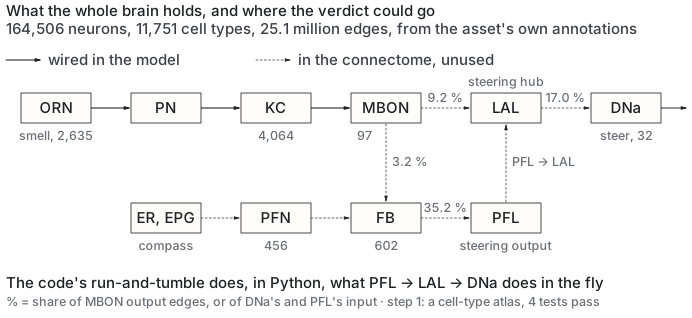
Where the readout goes. The 97 MBONs' 38,617 output edges land on CRE 13.5%, SMP 11.8%,
MBON 10.1%, LAL 9.2%, CB 6.8%, SIP 4.5%, lateral horn ~9%, FB 3.2%, PAM 2.5%. SMP
and CRE are themselves the largest external inputs to the FB (9.7% and 5.0%). So the mushroom
body's verdict reaches the central complex directly and through SMP/CRE, and reaches the
lateral accessory lobe directly.
What drives steering. The DNa class (which includes DNa02) receives PS 19.6%, LAL
17.0%, GNG 6.6%, CB 6.3%, VES 5.9%, AOTU 4.1%. The CX steering output PFL receives FB
35.2%, FC 15.3%, Delta 12.8%, hDelta ~14%, EPG 2.6%. The fly's own navigation stack —
compass (ER/EPG) → PFN → hDelta/vDelta → PFL → LAL → DNa — is intact in the asset.
Modulators outside the mushroom body. Non-MB dopamine (FB tangentials, PPM, LoVC…)
projects to AVLP 11.1%, FB 5.8%, KCs, LC, hDeltaB 2.1%. Octopamine (EN/OA/EL, 101 nodes)
projects to AVLP, CB, the visual system (TmY/Tm/Pm/LC), ER, SMP, LAL. Serotonin (48)
to ER, CB, GNG, SMP, FB.
Sensory entry. ORN → lLN/glomeruli (olfaction, the only pathway the current model uses).
JO → AMMC/SAD/CB and directly to DNg/DNge/DNp (mechanosensation reaches descending neurons
in one hop). LC → PVLP/AOTU (optic glomeruli → DN). MeTu → TuBu → ER (visual heading into the
compass).
Consequence. The only pathway the model wires is ORN→PN→KC→MBON, and the only place it
reads is MBON. The paths from MBON to LAL and FB, from FB to PFL, and from LAL to DNa exist
with thousands of measured contacts and nothing in the code traverses them for a decision.
The run-and-tumble in Forager is doing, in Python, what PFL→LAL→DNa does in the asset.