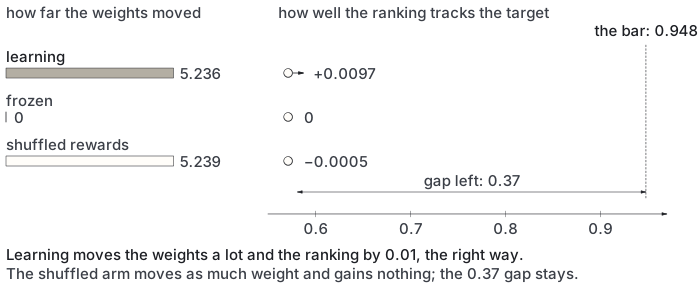
Does learning at the fly's learning site close the gap to the simple formula?
No. Learning moved the ranking by 0.01 against a gap of 0.37, although the weights changed a lot.
In the log: Does the plasticity help? Learning, frozen and shuffled-reward arms
recordedDate 2026-09-12, as written in the logunclassified0 predictions · 1 result paragraphEXPERIMENTS.md lines 566–608
What E15 did and how it came out, drawn from this record and the files it names (book/assets/diagrams/exp/E15.svg).
Results
EXPERIMENTS.md · line 579
Result.
The full record
EXPERIMENTS.md · lines 566–608
E15 — Does the plasticity help? Learning, frozen and shuffled-reward arms
Date 2026-09-12 · QuestionE12 left open whether KC->MBON plasticity - the
point of the architecture - closes the gap to the composition baseline. ·
Provenance…/learning_test.py
Method.MushroomBody with the channel encoder and compartment readout, learning
rate 0.05, six epochs over the 64 candidates in random order. Reward is the
standardised negative mixing enthalpy (lower dH is better), minus a running baseline.
Objective computed with MACE-MPA-0 averaged over 8 occupancies, spanning -100.7
to +181.4 meV/atom. Three arms: learning, frozen (no update), and shuffled rewards
(reward paired with the wrong candidate).
Result.
arm
rho before
rho after
change
|dw| total
learning
-0.5713
-0.5810
+0.0097
5.236
frozen
-0.5713
-0.5713
0.0000
0.000
shuffled rewards
-0.5713
-0.5708
-0.0005
5.239
Bar to beat: composition-only ridge, leave-one-out, 0.948 (E12).
Interpretation. The frozen arm is exactly unchanged, so the measurement is clean.
The learning arm improves where the shuffled arm does not, with near-identical weight
motion (5.236 against 5.239), so the rule is directionally real - it depends on
the pairing between action and outcome, which is the minimum a learning rule must do.
But the effect is 0.01 against a gap of 0.37. Plasticity does not close it, and
at this rate could not.
The pathology is the same one, and it survived every fix. Weight norm moves by
5.24 while the function moves by 0.01 - the same signature as the original null, where
‖dw‖ of 111 moved every selection probability by at most 0.0015. It has now survived
a named readout, an anatomy-derived valence assignment, an element-channel encoder,
and plasticity confined to the real learning site. Large weight motion with negligible
functional change is the persistent finding of this project, not an artefact of any
one design choice.
Caveats. One run per arm, so the 0.01 learning-minus-shuffled difference has no
error bar and should not be called significant without repeats across seeds. Six
epochs and one learning rate; no sweep was done. The objective is MACE-MPA-0's mixing
enthalpy, which is largely a function of composition by construction (E12).
Related entries
E12 — The control that sets the bar: composition-only regression