No result paragraph for this entry was found in the log.
EXPERIMENTS.md · lines 7071–7111E119 — The ladder written down, and what writing it down found
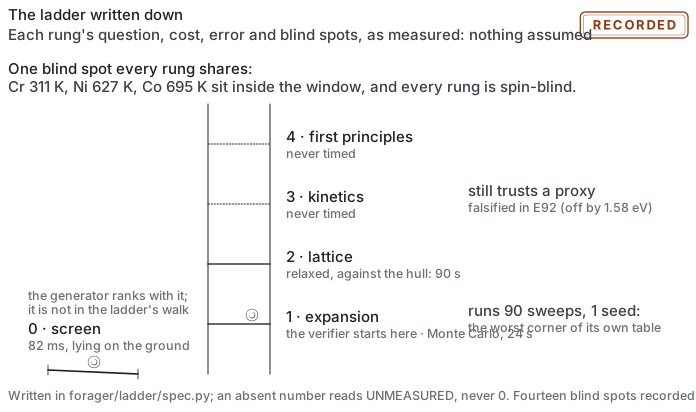
forager/spec.py states each rung of the fidelity ladder as measured: its question, cost,
error, promotion rule and blind spots. Nothing in it runs a calculation. Every number
carries where it came from, and an absent number reads UNMEASURED rather than zero - which
is the failure mode it exists to stop, since rung costs are hardcoded 0.0 elsewhere.
The first draft was wrong, and being wrong is what made this worth doing. It described an
idealised ladder - screen, ordering, relaxation, DFT. The ladder that runs is:
0 · screen              0.082 s    NOT IN THE WALK
1 · expansion          24.000 s
2 · lattice            90.000 s
3 · kinetics         UNMEASURED
4 · first principles UNMEASURED
Four findings, none of which were visible before the rungs were laid side by side.
1. The generator and the verifier do not start at the same rung. Verifier.__call__
begins at expansion, the Monte Carlo. screen - the 82 ms function - is not in its walk at
all; it is what stage_b calls. So the generator ranks compositions with one model and the
ladder begins verifying with a different, 300-times dearer one. That is why E117 could rank
1705 compositions in minutes while the ladder cannot.
2. Rung 1 runs at the worst corner of its own budget table. Verifier.expansion
hardcodes steps_per_site=90, seeds=(1,). E113 measured exactly that setting at 67 K
scatter and a +11 per cent bias no number of seeds removes. The 300- and 1000-sweep
settings that fix it exist, in forager.rungs.default_ladder - and expansion never
consults them. The precision sub-ladder is built and not wired in.
3. Rung 3's number is not trustworthy and the rung still runs. The Q proxy was falsified
in E92 - over-predicted by 1.58 eV on an 8-element alloy, in the unsafe direction. Nothing
was changed afterwards, so a candidate can still be promoted on it.
4. Two of five rungs have never been timed, so no budget over the ladder can be planned.
Five fields across the ladder are unmeasured; spec.unmeasured() lists them.
Fourteen blind spots are recorded, and one is shared by every rung: Cr's Neel transition
at 311 K, Ni's Curie point at 627 K and Co's hcp-fcc transition at 695 K all sit inside the
90-1000 K window, and the expansion and MACE are both spin-blind. No rung of this ladder
can see the way its current best candidate most likely fails. That is task 2 of the night.