Would a newer learned energy model that shares information between elements serve us better?
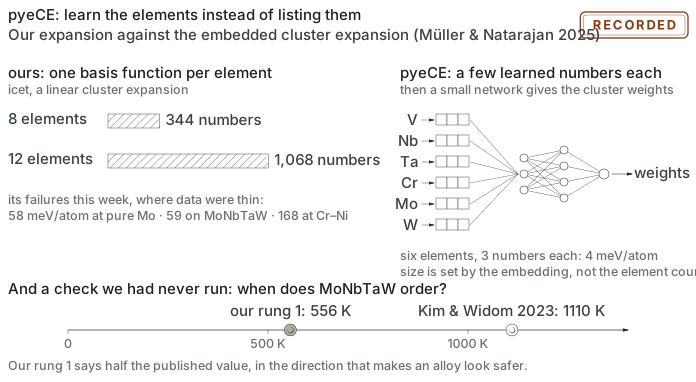
Yes. It probably should replace ours: it stays compact as elements are added and reached 4 meV/atom on six elements.
In the log: pyeCE: what it is, and why our expansion should probably be replaced by it
recordedDate not stated in the log; it was written between the commit of 2026-09-13 08:16 and the first commit that contains it, 2026-09-16 02:04rung 0 · energy model0 predictions · 0 result paragraphsEXPERIMENTS.md lines 6232–6281
What E107 did and how it came out, drawn from this record and the files it names (book/assets/diagrams/exp/E107.svg).
Results
No result paragraph for this entry was found in the log.
The full record
EXPERIMENTS.md · lines 6232–6281
E107 — pyeCE: what it is, and why our expansion should probably be replaced by it
Asked twice and answered properly only now.
We are not using it. Our expansion is icet 4.0, conventional linear cluster expansion,
344 parameters at eight elements and 1068 at twelve.
pyeCE is the embedded cluster expansion - Müller & Natarajan, npj Computational
Materials 11, 60 (2025), with the software released as epfl-mades/pyece and described in
arXiv:2609.10190 (September 2026). Instead of one basis function per species, which is what
makes a conventional expansion intractable past three or four elements, it learns a
low-dimensional embedding of the species and computes the cluster coefficients with a
neural network. The parameter count stops exploding with element count.
Its demonstration case is very close to ours. The method paper builds a single model
across the full composition space of the six-component V-Nb-Ta-Cr-Mo-W alloy - six of our
twelve, including chromium - and reaches 4 meV/atom with a three-dimensional embedding.
The software paper demonstrates a nine-component refractory alloy as one model, resolving
short-range order and order-disorder behaviour, which is our rung 1.
The property that matters most to us is the one we are failing on. eCE "leverages
similarities between chemical elements to efficiently extrapolate into compositional spaces
that are not explicitly included in the training dataset" - they withhold element pairs
entirely and the model still captures the withheld alloy's energetics. Every serious defect
in our expansion this week is a failure of exactly that: 58 meV/atom error at pure
molybdenum against a quoted 5.67 CV (E72), 59 meV/atom over-reporting on MoNbTaW, and a
168 meV/atom error at Cr0.64Ni0.36 because the four late transition metals are sparse in a
training set built by sampling (E104).
And there is a direct external check on rung 1 we have never run. Kim & Widom, Phys.
Rev. Materials 7, 063803 (2023), model MoTa and MoNbTaW on the bcc lattice and put the
A2→B2 transition for MoNbTaW at T_c ≈ 1110 K, with the ordering driven by Mo-Ta pairs and
a second transition below 300 K into B2-MoTa plus B32-NbW. Our rung 1 gives 556 K for the
same alloy - a factor of two low, and in the direction that makes an alloy look safer than
it is. That is a validation target sitting in the literature that costs nothing to compare
against.
Sources:
https://arxiv.org/abs/2609.10190
https://github.com/epfl-mades/pyece
https://doi.org/10.1038/s41524-025-01543-3
https://doi.org/10.1103/physrevmaterials.7.063803
Related entries
E72 — A pure element screened as stable, and the relaxation model was not to blame
E104 — Cr-Ni was a model error. The uncertainty term was right and I was about to remove it.