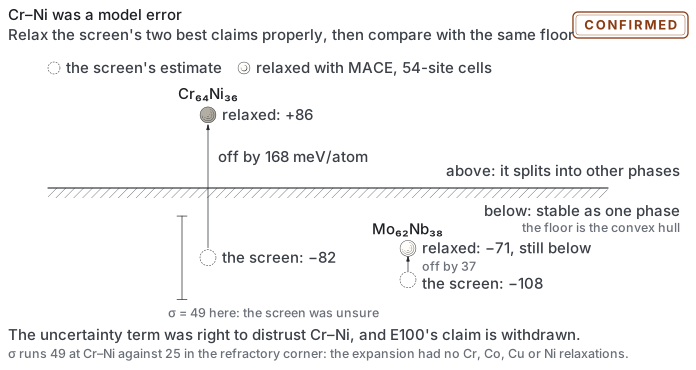
Would the screen's claim that chromium–nickel is stable survive a proper relaxation?
No. Relaxed properly, chromium–nickel sits 86 meV/atom above the stability floor; the uncertainty term was right to distrust it.
In the log: Cr-Ni was a model error. The uncertainty term was right and I was about to remove it.
confirmedDate not stated in the log; it was written between the commit of 2026-09-13 08:16 and the first commit that contains it, 2026-09-16 02:04unclassified0 predictions · 0 result paragraphsEXPERIMENTS.md lines 6068–6101
What E104 did and how it came out, drawn from this record and the files it names (book/assets/diagrams/exp/E104.svg).
Results
No result paragraph for this entry was found in the log.
The full record
EXPERIMENTS.md · lines 6068–6101
E104 — Cr-Ni was a model error. The uncertainty term was right and I was about to remove it.
Fable predicted the Cr-Ni result would not survive a real relaxation and named the test.
Run: 54-site cells, cell and ions relaxed with MACE, two occupations each, compared against
the same hull the screen uses.
composition
screen said
relaxed, same hull
error
Cr0.64 Ni0.36
-82
+86
168 meV/atom
Mo0.62 Nb0.38
-108
-71
37
Cr-Ni is a false positive. It is 86 meV/atom above the hull, not 82 below, and the screen
was wrong about it by 168. Mo-Nb survives at -71, inside the screen's own error bar - it is
real as a solid solution, though it orders once the bcc superstructures are admitted (+31
against the full hull).
So E100 is withdrawn in full. "Cr-Ni is competitive and the search is at fault" was wrong
on both halves. The composition is not competitive, and the uncertainty term - sigma, which
runs 49 there against 25 in the refractory corner because the expansion has no Cr/Co/Cu/Ni
relaxations to stand on - was correctly de-ranking a claim from the model's edge. It is
the same instrument that caught pure vanadium at -91 in E72, doing the same job, and I spent
the evening arguing it should be removed.
Two independent analyses converged on why. The second found that the anchor term is an
algebraic identity that cancels for every composition, so the whole composition-dependent
content of the relaxation correction is the single constant 4.94 on the size-misfit term -
and that constant was fitted on 120 relaxations containing no Cr, Co, Cu or Ni at all.
Two forms indistinguishable on that fit set (leave-one-out 24.3 against 24.5) diverge by
122 meV/atom at Cr0.64Ni0.36. The measurement above lands in that gap.
And I mis-compared hulls on the way, quoting relaxed energies against the hull containing
bcc orderings while the screen used the one without - a question every solid solution loses
at 0 K by construction. Caught before reporting, but it is the three-convention trap again
and it was the third time this week.
Related entries
E100 — Why only tantalum and tungsten: the search, not the physics
E72 — A pure element screened as stable, and the relaxation model was not to blame