Does the real fly wiring search alloy space better than a shuffled copy of itself?
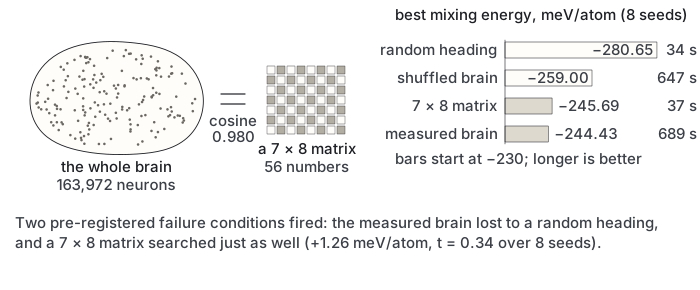
No. The real wiring lost to a shuffle (−244.4 vs −259.0 meV/atom, lower is better), and a 7 × 8 table did as well.
In the log: Pre-registration: does the measured wiring search better than a shuffle?
falsifiedDate not stated; the file was added to git on 2026-09-16 02:04unclassified0 predictions · 0 result paragraphsPREREGISTER_wholebrain.md lines 1–60
What PREREGISTER:wholebrain did and how it came out, drawn from this record and the files it names (book/assets/diagrams/exp/PREREGISTER-wholebrain.svg).
Pre-registration
Results
No result paragraph for this entry was found in the log.
The full record
PREREGISTER_wholebrain.md · lines 1–60
Pre-registration: does the measured wiring search better than a shuffle?
Written before the end-to-end comparison finished, so that the conditions under which
the hypothesis fails are on record rather than chosen afterwards.
The hypothesis, narrowed
Not "a biological brain is a better generator". That is not falsifiable and there is no
principled reason to expect a fly's wiring to suit alloy search, which has no relation to
anything a fly does. The claim under test is:
Under a declared distribution of interfaces, starting compositions and objectives,
the measured connectivity induces proposal statistics that make the search reach a
lower mixing energy per evaluation than degree-preserving shuffles of the same graph.
What is held identical across arms
Objective, evaluation budget, starting compositions, step size, minimum fraction, restart
patience, the readout projection seed, and the search seed. The common-mode calibration is
performed separately for every graph from the same objective-free reference
compositions, so that a control does not inherit the measured brain's centring and acquire
a constant drift.
Declared failure conditions
The measured brain loses or ties end-to-end under this protocol. The practical
superiority hypothesis fails for this protocol. It is reported as a failure, not
reframed.
The advantage holds for only one interface. Element-to-glomerulus assignment and
the motor projection are both arbitrary. If the result survives only one of them, the
claim is restricted to that composite algorithm and may not be stated as a property of
the connectome.
A 7x8 affine map reproduces it. Row-normalisation makes the dynamics contractive
for gain below one, so if the rectification pattern is stable over the compositions
visited, the whole brain collapses to d(x) = A log(1 + x/0.05) + b. If that small map
reproduces both the headings and the search performance, the claim that whole-brain
complexity is necessary is retired, whatever the end-to-end numbers say.
A matched random proposal field reproduces it. If a synthetic field matched for
magnitude, covariance and spatial correlation searches as well, the finding is about
proposal geometry and not about this connectome.
The decode gap is explained by path length. Shuffling can shorten the route from
receptors to descending neurons. If the measured and shuffled graphs differ in
sensory-to-descending path length, the 50 ms decode difference is partly a measurement
of route length and must be reported as such.
What may not be claimed
No significance from three null graphs: a randomisation test over three draws bounds the
one-sided p at 1/4, regardless of how many compositions are decoded. More null graphs, not
more compositions.
A trained probe recovering energy from the population code shows that energy is accessible
to that probe. It does not show the fixed motor projection exploits it. The two are
reported separately.
The objective is a cluster expansion fitted to MACE-MPA-0. It is a physically motivated
model, and a search method can preferentially find its errors, because different proposal
fields visit different parts of its domain. Finalists from every arm - including the
comparable losers - are re-evaluated with a stronger evaluator before any materials claim
is made.
Files it names
PREREGISTER_wholebrain.md
Paths in the Forager repository, as the log wrote them.