EXPERIMENTS.md · lines 274–324E9 — The ranking becomes a circuit property
Date 2026-09-12 · Question Can the seed-dependence of E8 be removed by taking
the encoder and the readout from the anatomy instead of a random generator? ·
Provenance forager/mushroom.py, …/final_enc.py
Method. Two changes, each replacing an arbitrary choice with a measured one.
Encoder (encoder="channel"). A projection neuron in a fly carries one glomerulus,
and a mixture is encoded combinatorially across channels. So one element is one
channel: each PN type, in sorted order, is assigned to one of the eight refractory
elements, and a candidate is presented as its eight atomic fractions. Deterministic,
no seed.
Readout (readout="compartment"). Each mushroom-body compartment is taught by a
dopaminergic population, and those populations carry opposite valence — PAM
appetitive, PPL1 aversive. Each MBON is read with the sign of its own compartment,
computed from measured contacts as (PAM - PPL) / (PAM + PPL). Deterministic.
Four seeds; with both changes the only remaining seed-dependence is the per-neuron
bias. 64 real RHEA candidates, full asset (166,700 nodes, 25,582,938 edges).
Result.
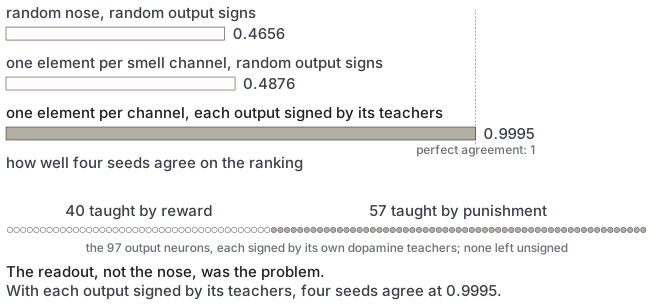
Every pairwise rho >= +0.9992. MBON valence resolves to 40 appetitive, 57 aversive,
0 unlabelled — every MBON receives dopaminergic input, so the assignment is
complete and entirely data-derived.
Checks against degeneracy: r(score, number of components) = -0.15, so the score is
not merely counting elements the way the ideal-entropy term does; and the
standardised policy spans 28.7x best to worst.
Interpretation. The encoder was not the binding constraint — swapping it alone
changed nothing (0.4656 -> 0.4876). The readout was: a random sign pattern over 97
MBONs is an arbitrary choice, and the ranking followed it rather than the circuit.
Taking valence from dopaminergic innervation makes the score a measured property of
the wiring.
This is the precondition for every control in chapter 11. Until the ranking was
stable, a comparison against a rewired graph could not mean anything, because the
measured and rewired arms would have differed by seed noise larger than any effect.
It is now meaningful, and is the next experiment.
Not yet claimed. That the ranking is stable says nothing about whether it is
good. Stability makes the wiring testable; it does not show the wiring helps.