Experiments · E7
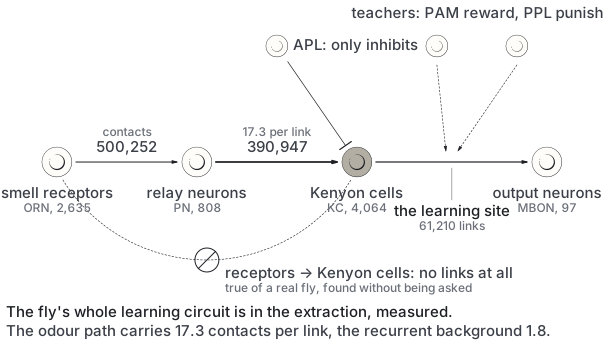
Is the fly's own learning circuit present, complete, in the imported brain? Yes. Every pathway is there, with 61,210 connections at the learning site, and smell receptors correctly never connect to it directly.
In the log: The measured mushroom-body pathway
Date 2026-09-12, as written in the log0 predictions · 0 result paragraphsEXPERIMENTS.md lines 208–230
Files checked (2)
data/malecns_mushroom.json data/malecns_mushroom.npz Numbers confirmed (5)
claim: KC->MBON 61,210 edges, 463,640 contacts; source: mushroom asset, KC/MBON blocks; ok: true claim: PN->KC 22,598 / 390,947; APL->KC 4,633 / 196,200, APL GABAergic; source: mushroom asset; ok: true claim: PAM->KC/MBON 110,450/2,693 (173,789/28,546); PPL 18,663/467 (51,338/11,165); source: mushroom asset; ok: true claim: MBON->MBON 56% and MBON->PAM 66% inhibitory; MBON->PAM 2,119 / 6,585; source: mushroom asset, consensus transmitter of the presynaptic cell; ok: true claim: 17.3 contacts per PN->KC edge against 1.8 per KC->KC edge; source: 390,947/22,598 and 1,153,844/642,932; ok: true Discrepancies
KC->KC (642,932 / 1,153,844) and MBON->MBON (1,605 / 26,258) are each one edge lower on disk than recorded; the current asset removes self-edges. ORN rows (ORN->PN, ORN->KC = 0) cannot be checked here: the mushroom asset holds no receptor neurons. Status the catalogued status fits the text
The pathway table recomputes from the stored mushroom-body asset to the edge, apart from two self-edges the newer extraction drops.
From runs/site_data/exp_checks/E7.json; the log itself is not edited.
Results No result paragraph for this entry was found in the log.
The full record EXPERIMENTS.md · lines 208–230 E7 — The measured mushroom-body pathway
Date 2026-09-12 · Question Is the fly's own learning circuit present in the
extraction, and at what strength? · Provenance full-asset extraction
Interpretation. The complete circuit is present. ORN -> KC = 0 is correct fly
anatomy reproduced from raw tables without being asked for — an unaided check on the
extraction. Contact counts say PN->KC synapses carry 17.3 contacts per edge against
1.8 for KC->KC, so the measured anatomy makes the odour pathway an order of
magnitude stronger than the recurrent background.
← Previous E6 · Was the old importer keeping all of the fly brain's connections?Next → E8 · Does reading a named group of output neurons give a stable ranking of…