No result paragraph for this entry was found in the log.
EXPERIMENTS.md · lines 1202–1255E26 — Why the cluster expansion is fitted to a potential and not to DFT
Date 2026-09-12 · Question (operator) The expansion inherits the potential's
error. RHEA is real DFT in exactly this chemistry - why not fit to that directly, or to
the large public DFT sets? · Provenance …/{rhea_ce_probe,ce_from_dft, rhea_ordered2,ce_ordered_dft}.py; RHEA, Zenodo 10.5281/zenodo.18863415
The answer is not "there isn't enough DFT". There is. It is the wrong shape.
A cluster expansion assigns energy to which atom occupies which site of a fixed
lattice at a fixed spacing. It has no way to represent an atom that has moved off its
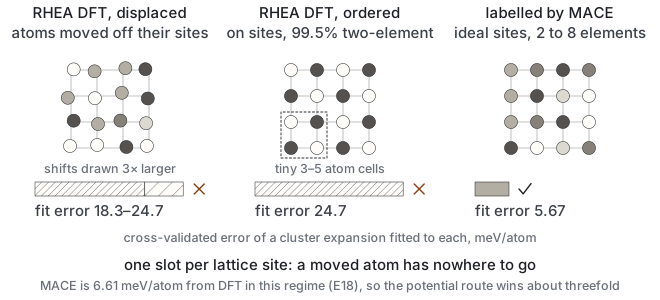
site, or a cell that has changed volume. Both groups of RHEA DFT fail on one of those:
bcc_alloys sits at 0.138 A RMS off-site - 4.8% of a bond length, in 1,453 of 1,454
structures. That displacement costs +125.5 meV/atom, with 36.5 meV/atom of scatter
between compositions (MACE-MPA-0 on the same cells, displaced versus ideal). The
scatter is what a fixed-lattice expansion must swallow as noise, and it is four times
the quantity being predicted. Cutting the expansion from 344 parameters to 64 changes
the answer by 1 meV/atom, so this is not a shortage of data per parameter.
bcc_alloys_ordered does sit on the lattice - median displacement 0.000 A under
icet's own mapper. But 1,549 of its 1,556 usable structures are binaries, in 3-to-5
atom cells, and they are relaxed ordered prototypes: mixing energies from -191 to +273
meV/atom. Training error 21 against CV 25 means the expansion is underfitting - it
cannot represent them, because their relaxation is in the energy and not in the
occupancy.
The architectural reason, which generalises past RHEA. A cluster expansion is not a
model of materials. It is a model of one lattice, one element set, one spacing. Each
parameter means "what it costs when a Nb sits beside a Ta at 2.85 A on bcc". There is
no parameter that a lithium cathode, an fcc nickel compound, or a triclinic Alexandria
prototype could inform - not for want of effort, but because there is no slot to put
it in. Pooling general DFT into it is not a thing that can be done.
A foundation potential is the opposite: one set of weights shared across all chemistry,
so every structure anywhere improves it. That is why the pipeline routes through one.
OMat24, MPtrj and Alexandria train MACE; MACE then labels exactly the structures the
expansion needs - ideal sites, fixed volume, 2 to 8 elements - which nobody has ever
computed with DFT because there would be no reason to. 1,953 of them take 95 seconds.
The handoff is measured, not assumed: MACE-MPA-0 is 6.61 meV/atom from DFT in this
exact regime, on 300 independent RHEA structures (E18). Fitting to the potential costs
that; fitting to the available DFT costs 18-25. The potential route is better by
roughly threefold, and it is the only one that reaches the multi-element cells at all.
What DFT is still for. Validating the potential (E18), and eventually correcting the
expansion where it matters most - a delta fit on the few multi-element on-lattice points,
rather than a fit from scratch. RHEA's value here was never as training data.