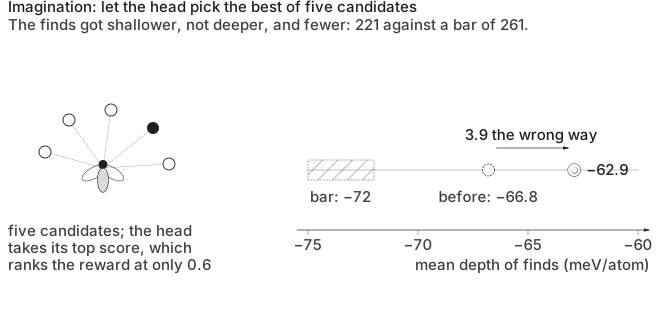
Does letting the brain imagine several candidates and pick the best give deeper finds?
No. Finds got shallower (−62.9 against a bar of −72 meV/atom) and fewer (221 against 261).
In the log: E202–E205 — the three fixes, one at a time, then together (2026-09-19 08:47; queued after E201 and E173c)
falsifiedDate 2026-09-19 08:47, as written in the loggenerator · fly brain0 predictions · 1 result paragraphEXPERIMENTS.md lines 12676–12695, lines 12886–12902
What E203 did and how it came out, drawn from this record and the files it names (book/assets/diagrams/exp/E203.svg).
Results
EXPERIMENTS.md · line 12886
E203 result (2026-09-20 03:49) — imagination FALSIFIED on both bars. fly + FORAGER_IMAGINE=4:
AUC_Q 102.7 (106.3 / 99.1), 221 finds (236 / 206), depth −62.9, ρ 0.61. Bars: depth
≤ −72 → −62.9, failed and in the wrong direction (3.9 meV shallower than baseline);
finds ≥ 261 → 221, failed. Letting the head pick among jittered candidates makes the finds
worse, not deeper: the score ranks the reward at ρ ≈ 0.6, so choosing the top-scored of
five candidates amplifies the score's error instead of the reward's signal, and it costs
coverage exactly as E202 did.
Both fixes I designed are falsified, and the reason is common to them.E201b showed the
fly already beats elitist on finds (284 vs 246); the deficit both fixes targeted — the late
stall — was an artifact of the gated reward and does not exist on the clean one. Each fix
trades the fly's real asset (coverage of the simplex) for exploitation it does not need.
Withdrawn with them: the spec's diagnosis ("explores well, exploits poorly") as the basis
for approaches 1 and 2. E204 (the Bennett rule) still runs — it changes learning, not the
proposal distribution, and ρ = 0.61 on the pure reward leaves room. E205 as specified is
void: "all three together" would combine two falsified changes; if E204 passes, E205
becomes E204's rule alone against elitist at three seeds.
The full record
This entry is written in 2 separate places in the log, shown here in log order.
EXPERIMENTS.md · lines 12676–12695
E202–E205 — the three fixes, one at a time, then together (2026-09-19 08:47; queued after E201 and E173c)
Correction to the E195/E195b tables above: the log's ± is the standard error over seeds
(sd/√n), not the population sd; score_arms.py reports the ddof-1 sd. Baseline = E195b fly:
AUC_Q 73.54 (s.e. 16.25, sd 23), 158 finds (sd 24), last-window finds 123 / 113, mean find
depth −61.9; elitist 88.90 / 169.5 / last-window 147, 139 / depth −74.4 (seed mean).
Code: branch fly-competitive (local search in Forager, imagination + history in
FlyGenerator, prediction_error in mushroom.py, flags + diagnostics in stage_b;
flags off reproduce E195b bit-for-bit by construction and by test). Predictions, each
before its run:
E202 local search (FORAGER_LOCAL_SEARCH=1): last-window finds ≥ 139 (elitist's floor)
and distinct finds ≥ 170; AUC_Q within one seed-sd of elitist. If the last window does
not move, the stall is not the walkers' memory and the anchor mechanism is wrong as built.
E203 imagination (FORAGER_IMAGINE=4): mean find depth deeper by ≥ 5 meV than −61.9;
finds unchanged within sd. Void if E201's score–reward correlation is < 0.2.
E204 RPE (FORAGER_RPE=bennett): score–reward correlation up by ≥ 0.10 over E201's
live arm; AUC_Q not worse.
E205 all three vs elitist, 3 seeds: fly AUC_Q ≥ elitist − one seed-sd, finds ≥
elitist, depth within 5 meV of elitist's. If E205 fails after E202 passed, the pieces
interfere and the combination is retuned one flag at a time, not all together.
EXPERIMENTS.md · lines 12886–12902
E203 result (2026-09-20 03:49) — imagination FALSIFIED on both bars. fly + FORAGER_IMAGINE=4:
AUC_Q 102.7 (106.3 / 99.1), 221 finds (236 / 206), depth −62.9, ρ 0.61. Bars: depth
≤ −72 → −62.9, failed and in the wrong direction (3.9 meV shallower than baseline);
finds ≥ 261 → 221, failed. Letting the head pick among jittered candidates makes the finds
worse, not deeper: the score ranks the reward at ρ ≈ 0.6, so choosing the top-scored of
five candidates amplifies the score's error instead of the reward's signal, and it costs
coverage exactly as E202 did.
Both fixes I designed are falsified, and the reason is common to them.E201b showed the
fly already beats elitist on finds (284 vs 246); the deficit both fixes targeted — the late
stall — was an artifact of the gated reward and does not exist on the clean one. Each fix
trades the fly's real asset (coverage of the simplex) for exploitation it does not need.
Withdrawn with them: the spec's diagnosis ("explores well, exploits poorly") as the basis
for approaches 1 and 2. E204 (the Bennett rule) still runs — it changes learning, not the
proposal distribution, and ρ = 0.61 on the pure reward leaves room. E205 as specified is
void: "all three together" would combine two falsified changes; if E204 passes, E205
becomes E204's rule alone against elitist at three seeds.
Related entries
E202 — E205 — the three fixes, one at a time, then together (2026-09-19 08:47; queued after E201…
E205 — E202–E205 — the three fixes, one at a time, then together (2026-09-19 08:47; queued after…
E201 — does the readout learn the real reward? (2026-09-19 08:12; queued next, operator's call)
E173c — result (2026-09-19 20:23) — the serotonin half of N6, legacy pair
E195 — the fly against the model-free arms on the real reward (2026-09-18 22:58, N1)