Do the walkers climb worse on the whole brain's landscape than on the mushroom body's?
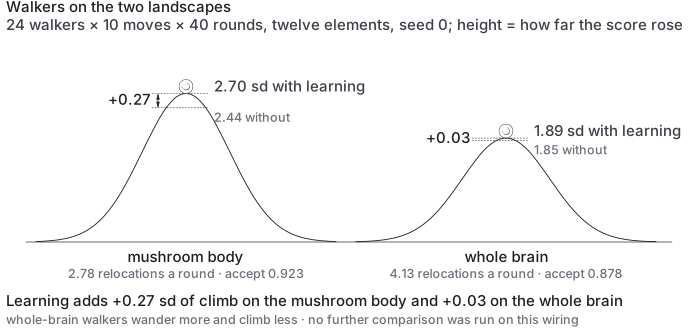
Yes. They relocate more and climb less; learning adds 0.27 standard deviations of climb on the mushroom body but only 0.03 on the whole brain.
In the log: The walk's own statistics on the two landscapes
mixedDate not stated in the log; it was written between the commit of 2026-09-16 19:06 and the first commit that contains it, 2026-09-19 08:35generator · fly brain0 predictions · 1 result paragraphEXPERIMENTS.md lines 10015–10048, lines 10050–10061, lines 10111–10144, line 10216
What E155 did and how it came out, drawn from this record and the files it names (book/assets/diagrams/exp/E155.svg).
Pre-registration
The pre-registration, as written
E155, first launch — one pass measured at the wrong setting, then a crash. The script
built the fly on REFRACTORY_BCC_A (8 elements) while stage_b.build() — which the search
and the learning-on reward both use — is the 12-element system with ce_12element; the
learning-on pass died on an 8-vector against 12 reference shifts. The mushroom learning-off
pass that completed first is therefore an 8-element measurement, not the search's:
Kept under runs/e155_walk.8elem.superseded.* and not used for the comparison. Relaunched
with the element set taken from build() for both modes, so the walkers are on the simplex
the search actually walked. The prediction is unchanged.
E155/E156 gate: 245 passed, 2 skipped, 197 warnings in 935.64s (0:15:35) — 4 new atlas tests; forager/brain/atlas.py is the only new code under forager/.
Results
EXPERIMENTS.md · line 10111
E155 result — the walk, 12 elements, 24 walkers x 10 moves x 40 rounds, seed 0.
learning OFF              mushroom   whole brain   ratio
accept fraction            0.923      0.878        0.95
relocations / round        2.78       4.13         1.49
travel / walker / round    0.317      0.406        1.28
gain per accepted step     0.173 sd   0.136 sd     0.78
climb over 40 rounds       2.44 sd    1.85 sd      0.76
learning ON
accept                     0.929      0.888        0.96
relocations / round        2.53       3.68         1.46
climb over 40 rounds       2.70 sd    1.89 sd      0.70
climb ADDED by learning   +0.27 sd   +0.03 sd      0.13
Prediction 1 confirmed — greedy acceptance is scale-free, 0.95. Prediction 2 at the
bound — 1.49 against ">= 1.5"; the direction is right and the magnitude sits on the line,
so it is not claimed as confirmed. Prediction 3 falsified as stated — the total climb
with learning on is x1.43, not x2.5 — but the decomposition says something sharper than the
prediction did: forty rounds of lessons add +0.27 sd of climb on the mushroom body and
+0.03 sd on the whole brain. On the current wiring, learning is nearly irrelevant to
where the whole-brain walkers go. Prediction 4 uninformative — basin sharing is ~0 on
both; twenty-four walkers on a twelve-simplex do not meet within L1 0.05.
The falsification condition is not met (relocate 1.49, travel 1.28 are outside 20%), so
the walk is part of the remainder: whole-brain walkers relocate half again as often, travel
more, gain less per step and climb a quarter less — they wander more and climb less — and
the lessons that redistribute the mushroom swarm barely touch them. Put with E154 (readout
learnability x0.61, shortcut share 76% → 83%): the walk's climb x0.76, the learning
contribution to that climb x0.13. A find is a threshold crossing inside 200 rounds; a
generator whose lessons do not move its walk crosses far fewer.
Standing instruction from task 0 applies: this is the mushroom body wired two ways, and
no further comparison is run on this wiring. Collected for the record; the repair is the
mapping.
The full record
This entry is written in 4 separate places in the log, shown here in log order.
EXPERIMENTS.md · lines 10015–10048
E155 — The walk's own statistics on the two landscapes
E154 left a factor of 2-3 in learning efficacy and an unexplained remainder to 10x. A find
is a threshold crossing inside 200 rounds, and a count of crossings is a steep function of
climb rate, so the walk itself is the next place to look. Forager.move is greedy
(temperature = 0): a step is kept if its score beats the walker's stored score, the
heading is kept on success and re-drawn on failure, and six failures in a row relocate the
walker to a fresh Dirichlet draw. Nothing in that rule depends on the scale of the score —
only on its ordering along a heading — so the x0.6 landscape amplitude of E154 cannot by
itself change one decision. What can is the landscape's roughness in direction: the
whole brain's shortcut path adds a composition-dependent term the readout never had.
Measured on both assets, seed-matched, 24 walkers x 10 moves per round, learning off:
accepted-step fraction, relocations per round, mean L1 travel per walker per round, score
gain per accepted step in units of the landscape sd, and the fraction of walkers sharing a
basin at the end (pairwise L1 < 0.05). Then learning on, with stage_b's own rung-0 reward.
Predicted:
Acceptance fraction within 20% on the two assets — greedy comparison is scale-free
and both landscapes are smooth at the step size.
Relocations per round at least 1.5x higher on the whole brain, because the shortcut
term makes the gradient direction change more often along a run, so headings fail
sooner than they would on the mushroom landscape.
With learning on, the mushroom walkers' score gain per round grows about 2.5x faster
— the E154 lesson-over-landscape ratio, 0.468 against 0.287, expressed as climb.
Basin sharing is higher on the whole brain (more walkers converge on the same
place), since the unlearnable shortcut fixes where the peaks are and lessons cannot
move them; on the mushroom asset lessons redistribute the swarm.
Falsified if acceptance, relocation and travel are all within 20% with learning off —
then the walk is not it either, and the remainder must sit in how a find is counted
(--confirm, the p >= 0.832 bar) rather than how it is found, which turns E156 into an
audit of stage_b's scoring of E145 and E152 rather than of the generator.
EXPERIMENTS.md · lines 10050–10061
E155, first launch — one pass measured at the wrong setting, then a crash. The script
built the fly on REFRACTORY_BCC_A (8 elements) while stage_b.build() — which the search
and the learning-on reward both use — is the 12-element system with ce_12element; the
learning-on pass died on an 8-vector against 12 reference shifts. The mushroom learning-off
pass that completed first is therefore an 8-element measurement, not the search's:
Kept under runs/e155_walk.8elem.superseded.* and not used for the comparison. Relaunched
with the element set taken from build() for both modes, so the walkers are on the simplex
the search actually walked. The prediction is unchanged.
EXPERIMENTS.md · lines 10111–10144
E155 result — the walk, 12 elements, 24 walkers x 10 moves x 40 rounds, seed 0.
learning OFF              mushroom   whole brain   ratio
accept fraction            0.923      0.878        0.95
relocations / round        2.78       4.13         1.49
travel / walker / round    0.317      0.406        1.28
gain per accepted step     0.173 sd   0.136 sd     0.78
climb over 40 rounds       2.44 sd    1.85 sd      0.76
learning ON
accept                     0.929      0.888        0.96
relocations / round        2.53       3.68         1.46
climb over 40 rounds       2.70 sd    1.89 sd      0.70
climb ADDED by learning   +0.27 sd   +0.03 sd      0.13
Prediction 1 confirmed — greedy acceptance is scale-free, 0.95. Prediction 2 at the
bound — 1.49 against ">= 1.5"; the direction is right and the magnitude sits on the line,
so it is not claimed as confirmed. Prediction 3 falsified as stated — the total climb
with learning on is x1.43, not x2.5 — but the decomposition says something sharper than the
prediction did: forty rounds of lessons add +0.27 sd of climb on the mushroom body and
+0.03 sd on the whole brain. On the current wiring, learning is nearly irrelevant to
where the whole-brain walkers go. Prediction 4 uninformative — basin sharing is ~0 on
both; twenty-four walkers on a twelve-simplex do not meet within L1 0.05.
The falsification condition is not met (relocate 1.49, travel 1.28 are outside 20%), so
the walk is part of the remainder: whole-brain walkers relocate half again as often, travel
more, gain less per step and climb a quarter less — they wander more and climb less — and
the lessons that redistribute the mushroom swarm barely touch them. Put with E154 (readout
learnability x0.61, shortcut share 76% → 83%): the walk's climb x0.76, the learning
contribution to that climb x0.13. A find is a threshold crossing inside 200 rounds; a
generator whose lessons do not move its walk crosses far fewer.
Standing instruction from task 0 applies: this is the mushroom body wired two ways, and
no further comparison is run on this wiring. Collected for the record; the repair is the
mapping.
EXPERIMENTS.md · line 10216
E155/E156 gate: 245 passed, 2 skipped, 197 warnings in 935.64s (0:15:35) — 4 new atlas tests; forager/brain/atlas.py is the only new code under forager/.
Related entries
E154 — The readout under recurrence: where 159,195 unread neurons reach the score
E156 — What the whole brain contains, and where the mushroom body's output actually goes
E145 — Does the whole brain help? One change from the baseline.
E152 — the matched control for the whole brain. Take two: the first launch never ran.