Was the 44.6 meV/atom error a comparison of like with like?
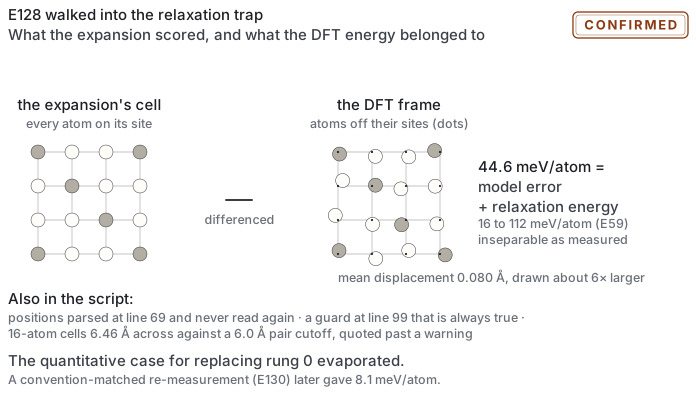
No. The model was scored on perfect lattice sites against quantum energies of displaced atoms, so relaxation energy counted as error.
In the log: E128 IS WITHDRAWN. The DFT comparison walked into the relaxation trap.
confirmedDate not stated in the log; it was written between the commit of 2026-09-16 09:57 and the first commit that contains it, 2026-09-16 10:56rung 4 · DFT0 predictions · 1 result paragraphEXPERIMENTS.md lines 7740–7796
What E129 did and how it came out, drawn from this record and the files it names (book/assets/diagrams/exp/E129.svg).
Results
EXPERIMENTS.md · line 7740
E129 — E128 IS WITHDRAWN. The DFT comparison walked into the relaxation trap.
scripts/validate/rhea_expansion.py parses each RHEA frame's atomic positions into
fr["positions"] at line 69 and never reads them again. Line 124 rebuilds an ideal bcc
cell with bulk("W","bcc",a=a0,cubic=True) and calls only set_chemical_symbols. So the
expansion was evaluated on perfect lattice sites and differenced against a DFT energy
belonging to a displaced structure.
Measured directly on the frames the script accepted: mean displacement from the ideal bcc
site is 0.080 A, median 0.077, and 80 per cent of atoms are displaced by more than 0.05 A.
Not one frame is undisplaced.
So 44.6 meV/atom is not rung 0's error against DFT. It is the expansion's error PLUS the
internal relaxation energy of the RHEA structures, and this project's own figure for
relaxation is 16 to 112 meV/atom (E59, physics/lattice.py:246) - the same order as the
number reported. The two are not separable from what was measured.
This is the relaxation leg of the three-convention trap, the exact failure
forager/physics/energies.py was written to prevent and that E65 was retracted for. The
entry that committed it is the one that instructed the project to replace its cheapest rung.
Withdrawn in full:
the 44.6 / 70.0 meV/atom figures and the whole stratified table;
prediction 1's "confirmed" - it was scored against a confounded measurement;
prediction 3's instruction that 44.6 "should replace the cross-validation figure wherever
rung 0's accuracy is quoted";
the conclusion that rung 0's advertised 9.09 understates its true error by that amount.
What is NOT withdrawn, because it does not depend on the confounded arithmetic:
rung 0's 9.09 is a fit residual against MACE and has never been checked against DFT. That
remains true and remains the open question.
data/rhea covers nine of our elements in VASP-PBE and was unused. Still true.
RHEA's DFT is not spin-polarised (do_spinpol = False), so training on it inherits the
blindness to Cr's 311 K transition. Independent of E128 and unaffected.
The project's own 2026-09-14 note warning against fitting mixing enthalpies to a foundation
model. Unaffected, and still unactioned.
Two further defects in the same script, both mine, both found by audit rather than by me:
rhea_expansion.py:99 - abs(fr["box"] / rep - fr["box"] / rep) < 1e-9 is identically
true. The commensurability guard its own comment describes does not exist; frames are
accepted on atom count alone. Latent here, because only n=16 and n=54 appeared.
The 2687 frames are almost all 16-atom cells at 6.46 A against a 6.0 A pair cutoff, which
icet warned about and which E128 recorded as a caveat and then quoted past anyway.
How the measurement must be done instead. Either evaluate the expansion on structures
that are genuinely unrelaxed, or subtract a measured relaxation energy per structure rather
than assuming one. RHEA's bcc_alloys group holds 2150 structures at 54 atoms in a 9.7 A box
clean of the cutoff problem - but they are randomly displaced too, so the convention issue
is the binding one, not the cell size. No number replaces 44.6 until that is settled.
Consequence for the plan. Tier 0.1 and the entire Tier 1 justification rested on this
figure. The pyeCE-on-RHEA rebuild may still be the right move - the argument from the
2026-09-14 note stands on its own - but the quantitative case for it has evaporated and
must be rebuilt before the work is done, not after.
The full record
EXPERIMENTS.md · lines 7740–7796
E129 — E128 IS WITHDRAWN. The DFT comparison walked into the relaxation trap.
scripts/validate/rhea_expansion.py parses each RHEA frame's atomic positions into
fr["positions"] at line 69 and never reads them again. Line 124 rebuilds an ideal bcc
cell with bulk("W","bcc",a=a0,cubic=True) and calls only set_chemical_symbols. So the
expansion was evaluated on perfect lattice sites and differenced against a DFT energy
belonging to a displaced structure.
Measured directly on the frames the script accepted: mean displacement from the ideal bcc
site is 0.080 A, median 0.077, and 80 per cent of atoms are displaced by more than 0.05 A.
Not one frame is undisplaced.
So 44.6 meV/atom is not rung 0's error against DFT. It is the expansion's error PLUS the
internal relaxation energy of the RHEA structures, and this project's own figure for
relaxation is 16 to 112 meV/atom (E59, physics/lattice.py:246) - the same order as the
number reported. The two are not separable from what was measured.
This is the relaxation leg of the three-convention trap, the exact failure
forager/physics/energies.py was written to prevent and that E65 was retracted for. The
entry that committed it is the one that instructed the project to replace its cheapest rung.
Withdrawn in full:
the 44.6 / 70.0 meV/atom figures and the whole stratified table;
prediction 1's "confirmed" - it was scored against a confounded measurement;
prediction 3's instruction that 44.6 "should replace the cross-validation figure wherever
rung 0's accuracy is quoted";
the conclusion that rung 0's advertised 9.09 understates its true error by that amount.
What is NOT withdrawn, because it does not depend on the confounded arithmetic:
rung 0's 9.09 is a fit residual against MACE and has never been checked against DFT. That
remains true and remains the open question.
data/rhea covers nine of our elements in VASP-PBE and was unused. Still true.
RHEA's DFT is not spin-polarised (do_spinpol = False), so training on it inherits the
blindness to Cr's 311 K transition. Independent of E128 and unaffected.
The project's own 2026-09-14 note warning against fitting mixing enthalpies to a foundation
model. Unaffected, and still unactioned.
Two further defects in the same script, both mine, both found by audit rather than by me:
rhea_expansion.py:99 - abs(fr["box"] / rep - fr["box"] / rep) < 1e-9 is identically
true. The commensurability guard its own comment describes does not exist; frames are
accepted on atom count alone. Latent here, because only n=16 and n=54 appeared.
The 2687 frames are almost all 16-atom cells at 6.46 A against a 6.0 A pair cutoff, which
icet warned about and which E128 recorded as a caveat and then quoted past anyway.
How the measurement must be done instead. Either evaluate the expansion on structures
that are genuinely unrelaxed, or subtract a measured relaxation energy per structure rather
than assuming one. RHEA's bcc_alloys group holds 2150 structures at 54 atoms in a 9.7 A box
clean of the cutoff problem - but they are randomly displaced too, so the convention issue
is the binding one, not the cell size. No number replaces 44.6 until that is settled.
Consequence for the plan. Tier 0.1 and the entire Tier 1 justification rested on this
figure. The pyeCE-on-RHEA rebuild may still be the right move - the argument from the
2026-09-14 note stands on its own - but the quantitative case for it has evaporated and
must be rebuilt before the work is done, not after.