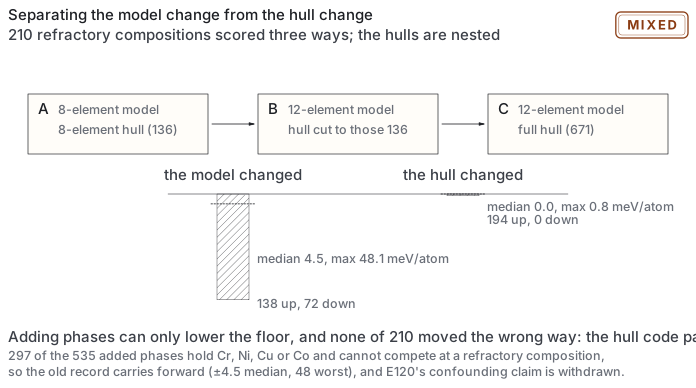
Did the larger set of competing phases, not the new energy model, shift old results?
No. The added phases moved refractory results by at most 0.8 meV/atom; the new energy model moved them by 4.5 meV/atom typically.
In the log: Separating the expansion change from the hull change
mixedDate not stated in the log; it was written between the commit of 2026-09-16 08:08 and the first commit that contains it, 2026-09-16 08:54rung 2 · hull, MACE0 predictions · 1 result paragraphEXPERIMENTS.md lines 7536–7570, lines 7572–7612
What E126 did and how it came out, drawn from this record and the files it names (book/assets/diagrams/exp/E126.svg).
Results
EXPERIMENTS.md · line 7572
E126 result: prediction 1 confirmed exactly, prediction 3 confirmed, prediction 2
FALSIFIED — and the falsification corrects E120.
210 compositions drawn only from the refractory eight, scored three ways:
effect                         median      max      sign
expansion  (B - A)                4.5     48.1      138 up, 72 down
hull       (C - B)                0.0      0.8      194 up, 0 DOWN
Prediction 1 confirmed, and this is the result worth having. Adding phases to a convex
hull can only lower the envelope, so drive = E_alloy - E_hull can only rise. Zero of 210
compositions moved the other way. That is a property the hull code must have and now
demonstrably does, on a test that would have caught a sign or indexing error immediately.
Prediction 3 confirmed: the expansion change is two-signed, 138 up and 72 down, median
4.5 meV/atom - somewhat smaller than the 10-20 predicted, with a tail to 48.
Prediction 2 falsified. The hull effect is not merely smaller than the expansion effect, it
is negligible: median 0.0, maximum 0.8 meV/atom.
The reason is obvious once measured and I should have seen it beforehand. Of the 535 database
phases added going from eight elements to twelve, 297 contain Cr, Ni, Cu or Co. A phase
containing an element can never lie on the hull at a composition where that element is absent,
because hull membership needs non-negative mixing amounts and nothing can cancel the extra
element. So for a refractory-only composition those 297 are not competitors at all, and the
238 that are refractory-only barely move the envelope.
This withdraws a claim in E120. That entry stated the hull change "is the one that moves
driving forces" and that "any comparison between a pre-E114 number and a current one is
confounded by it unless the hull is held fixed". Measured, that is wrong for the refractory
compositions the old record consists of. The hull change moves them by at most 0.8 meV/atom.
The confounding claim was reasoned, not measured, and is withdrawn.
What stands from E120: the hulls genuinely are nested and the twelve-element one genuinely
holds 535 more phases. What was wrong was the inference about magnitude. The correct statement
is: the eight-element record can be carried forward for refractory compositions, with an
uncertainty from the expansion refit of about 4.5 meV/atom median and 48 worst case, and an
uncertainty from the hull of under 1. For compositions containing Cr, Ni, Cu or Co the hull
change is of course decisive - those compositions had no hull at all before.
230 passing.
The full record
This entry is written in 2 separate places in the log, shown here in log order.
EXPERIMENTS.md · lines 7536–7570
E126 — Separating the expansion change from the hull change
"Re-measure the eight-element record on twelve" was written as though only the element set had
changed. E120 showed two things changed together: the expansion (344 parameters, CV 5.68 ->
1068 parameters, CV 9.09) and the hull (136 phases, all prototypes -> 671, the same 136
prototypes plus 535 database phases). A driving force is a distance below the hull, so a
straight 8-vs-12 comparison confounds the two.
They separate with a third scoring, because the hulls are nested. Filtering
offlattice_hull12.json down to its 136 prototypes reproduces the eight-element hull's
contents on the twelve-element indexing:
A   8-element CE   +  8-element hull (136 prototypes)      the old record
B   12-element CE  +  12-hull restricted to 136 prototypes  isolates the CE change
C   12-element CE  +  full 12-element hull (671)            current default
A against B is the expansion alone. B against C is the hull alone.
Predicted:
B minus C is one-signed: every composition's driving force is greater (less negative)
under the full hull than under the restricted one, with no exceptions. This is close to a
theorem rather than a guess - a convex hull is a lower envelope, so adding phases can only
lower it, and drive = E_alloy - E_hull can only rise. A single composition moving the
other way is a bug in the hull code, not a finding, and that is the most useful thing
this experiment can do.
The hull change dominates the expansion change. Median |B - C| exceeds median |A - B|,
because 535 new competitors is a larger perturbation than re-fitting the same MACE energies
on the same lattice with more elements.
A minus B is small and two-signed, of order the difference in cross-validation, 10 to
20 meV/atom, scattering both ways rather than trending.
Falsified if A and B differ by more than the hull effect, which would mean the
twelve-element expansion is not merely a wider fit of the same physics and the old
eight-element numbers cannot be carried forward at all.
EXPERIMENTS.md · lines 7572–7612
E126 result: prediction 1 confirmed exactly, prediction 3 confirmed, prediction 2
FALSIFIED — and the falsification corrects E120.
210 compositions drawn only from the refractory eight, scored three ways:
effect                         median      max      sign
expansion  (B - A)                4.5     48.1      138 up, 72 down
hull       (C - B)                0.0      0.8      194 up, 0 DOWN
Prediction 1 confirmed, and this is the result worth having. Adding phases to a convex
hull can only lower the envelope, so drive = E_alloy - E_hull can only rise. Zero of 210
compositions moved the other way. That is a property the hull code must have and now
demonstrably does, on a test that would have caught a sign or indexing error immediately.
Prediction 3 confirmed: the expansion change is two-signed, 138 up and 72 down, median
4.5 meV/atom - somewhat smaller than the 10-20 predicted, with a tail to 48.
Prediction 2 falsified. The hull effect is not merely smaller than the expansion effect, it
is negligible: median 0.0, maximum 0.8 meV/atom.
The reason is obvious once measured and I should have seen it beforehand. Of the 535 database
phases added going from eight elements to twelve, 297 contain Cr, Ni, Cu or Co. A phase
containing an element can never lie on the hull at a composition where that element is absent,
because hull membership needs non-negative mixing amounts and nothing can cancel the extra
element. So for a refractory-only composition those 297 are not competitors at all, and the
238 that are refractory-only barely move the envelope.
This withdraws a claim in E120. That entry stated the hull change "is the one that moves
driving forces" and that "any comparison between a pre-E114 number and a current one is
confounded by it unless the hull is held fixed". Measured, that is wrong for the refractory
compositions the old record consists of. The hull change moves them by at most 0.8 meV/atom.
The confounding claim was reasoned, not measured, and is withdrawn.
What stands from E120: the hulls genuinely are nested and the twelve-element one genuinely
holds 535 more phases. What was wrong was the inference about magnitude. The correct statement
is: the eight-element record can be carried forward for refractory compositions, with an
uncertainty from the expansion refit of about 4.5 meV/atom median and 48 worst case, and an
uncertainty from the hull of under 1. For compositions containing Cr, Ni, Cu or Co the hull
change is of course decisive - those compositions had no hull at all before.
230 passing.
Related entries
E120 — Reconciling the hull phase count, and what a fresh clone cannot do
E114 — The search space was eight elements, and the search collapses inside it