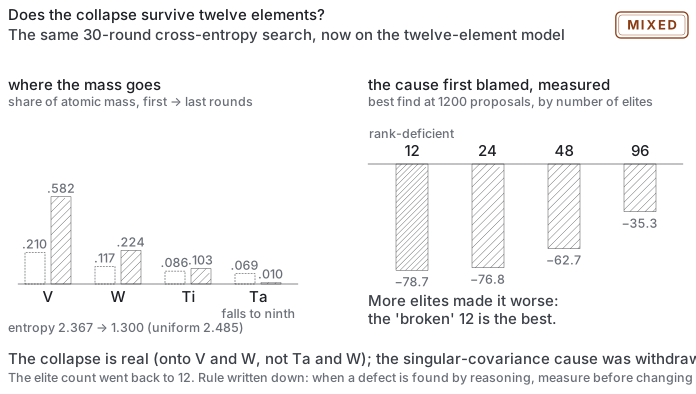
On twelve elements, does the search still collapse onto one corner of the composition space?
Yes. It collapses at least as hard, onto vanadium and tungsten; the statistical flaw first blamed was then measured and ruled out.
In the log: Does the collapse survive the wider space?
mixedDate not stated in the log; it was written between the commit of 2026-09-13 08:16 and the first commit that contains it, 2026-09-16 02:04search baselines0 predictions · 2 result paragraphsEXPERIMENTS.md lines 6783–6809, lines 6811–6859, lines 6861–6896
What E116 did and how it came out, drawn from this record and the files it names (book/assets/diagrams/exp/E116.svg).
Results
EXPERIMENTS.md · line 6811
E116 result: prediction 2 falsified. The search does not go to tantalum and tungsten on
twelve elements - it goes nowhere good at all.
Same protocol, twelve-element default:
element   early    late          early -> late
V         0.210   0.582     entropy    2.367 -> 1.300  (uniform ln 12 = 2.485)
W         0.117   0.224     supports      72 -> 19
Ti        0.086   0.103
Ta        0.069   0.010     <- ninth, not first
Predictions 1 and 4 confirmed: it still collapses, and it collapses at least as hard.
Prediction 2 falsified: V and W take the mass, Ta falls to ninth. Prediction 3 half
confirmed: Cr, Ni, Cu and Co are all driven under 2 per cent, so they are being rejected
rather than being absent, which was the point - but they are not the four smallest, Hf and Ta
are down there with them. The falsification condition did not trigger - none of the fcc
four holds over 5 per cent - so E114's diagnosis stands and is not withdrawn.
But the V-rich basin is not a find, and chasing that is what produced the real result.
Both expansions were asked the same question and they agree to a few meV/atom, so it is not a
fit artefact:
composition              8-element    12-element
V.58 W.22 Ti.10 Nb.10        +73.9         +72.9     <- rejected by the screen
V0.91 Mo0.09                 +15.2         +14.9
MoNbTaW                      -87.7         -71.7
Mo0.55 Ta0.45               -113.7         -82.4     <- the actual optimum
CrossEntropy maximises the negative of this, so it should have gone to Mo-Ta. It did not.
Over 240 proposals on twelve elements its best find was +36.5 meV/atom - nothing stable
at all.
Cause: the elite count does not scale with the dimension, so the covariance is singular.np.cov of elite points in n dimensions has rank at most elite - 1, and elite was
hardcoded at 12 against twelve elements. The fitted Gaussian sampled inside a degenerate
subspace. On eight elements 12 elites for an 8x8 covariance is merely marginal, which is why
this survived unnoticed. elite now defaults to max(12, 4 * n_elements).
The fix is not yet justified by measurement and must not be treated as settled. At 240
proposals it makes things worse - best +93.7 against +36.5 - because 48 of those proposals
go to random seeding and the remaining 192 cannot converge. That says the budget is too small
for twelve dimensions either way, not that singular covariance is preferable. A sweep of
elite in {12, 24, 48, 96} at 1200 proposals, two seeds, is running to settle it.
Consequence for E115, which is running now: it was launched before this change, so its
CrossEntropy arm uses elite = 12 on twelve elements - the rank-deficient setting. E115
therefore compares MAP-Elites against a weakened baseline and cannot be read as a fair
verdict on quality-diversity. It must be re-run against whichever elite count the sweep
selects before any conclusion is drawn from it.
EXPERIMENTS.md · line 6861
E116 correction: the causal claim above is WITHDRAWN.
The entry blamed CrossEntropy's failure on the twelve-element space on a rank-deficient
covariance, and changed the elite count on that basis. The sweep it called for falsifies it.
1200 proposals, twelve elements, two seeds, best driving force in meV/atom:
Monotonically worse as the elite count grows, and the rank-deficient setting is the best of
the four. 12 and 24 differ by 1.9 meV/atom on two seeds, which is noise; 48 and 96 are
clearly worse. The reason is the one already visible at 240 proposals: the arm samples
uniformly until it holds elite observations, so a larger elite starts later and has less
budget left to converge.
So the singularity is real as arithmetic and is not the cause of anything measured. The
floor regularisation handles the deficient direction. What actually broke CrossEntropy at
240 proposals was the budget: given 1200 it finds Ta0.55 Mo0.42 at -78.7 whatever the elite
count. elite is restored to 12, now documented with the sweep that justifies it rather
than with a rank argument that does not. 227 passing.
Two consequences.
First, E115 is NOT compromised and the warning written against it is withdrawn. It is
running with elite = 12, which this sweep identifies as the best of the four settings, so
its CrossEntropy arm is the strongest baseline available rather than a crippled one. E115 can
be read as a fair test when it lands.
Second, and worth recording as a pattern rather than an incident: this is the second time in
this session that a repair was shipped with a stated cause that later measurement falsified -
the first was the claim that the centre-of-mass estimator scattered four times more than the
parabolic peak, which turned out to be a drift-mask defect in the repair itself (E113). Both
times the fix was written before the measurement that was supposed to justify it. The rule
this suggests: when a defect is identified by reasoning rather than by measurement, run the
measurement before changing the code, not after.
The full record
This entry is written in 3 separate places in the log, shown here in log order.
EXPERIMENTS.md · lines 6783–6809
E116 — Does the collapse survive the wider space?
E114 measured CrossEntropy concentrating onto W and Ta, but it ran on the eight-element
expansion, before the default was widened. That measurement describes a search we no longer
run, so it cannot be left standing as the diagnosis without being repeated. Identical protocol
30 rounds, 8 proposals, drive_conservative, same seed - on the twelve-element default.
The four added elements are the four worst on a bcc lattice. Their shared-lattice elemental
anchors are Cu 505.3, Cr 975.1, Ni 994.8 and Co 1100.1 meV/atom, against Nb 4.4 and Ta 6.1.
A search that rewards driving force should discard them almost immediately.
Predicted:
CrossEntropy still collapses. Element-mass entropy falls substantially from its
starting value, which is now against a uniform ln(12) = 2.485 rather than ln(8) = 2.079.
W and Ta still take the largest share, because the landscape's optimum is still Mo-Ta;
adding elements that cannot compete does not move a peak.
The fcc four - Cr, Ni, Cu, Co - are driven below 2 per cent atomic mass each, and are
the four smallest at the end. They are being rejected, which is the correct behaviour
and is different from being absent, which is what E114 found.
Late entropy lands near or below the 1.443 measured on eight elements, because the
extra four are eliminated rather than explored, so the effective space is not larger.
Falsified if any of Cr, Ni, Cu or Co holds more than 5 per cent of the atomic mass at the
end, in which case the twelve-element landscape is genuinely different, E114's diagnosis
was measured on the wrong space and must be withdrawn rather than carried forward, and the
E115 comparison now running needs re-reading in that light.
EXPERIMENTS.md · lines 6811–6859
E116 result: prediction 2 falsified. The search does not go to tantalum and tungsten on
twelve elements - it goes nowhere good at all.
Same protocol, twelve-element default:
element   early    late          early -> late
V         0.210   0.582     entropy    2.367 -> 1.300  (uniform ln 12 = 2.485)
W         0.117   0.224     supports      72 -> 19
Ti        0.086   0.103
Ta        0.069   0.010     <- ninth, not first
Predictions 1 and 4 confirmed: it still collapses, and it collapses at least as hard.
Prediction 2 falsified: V and W take the mass, Ta falls to ninth. Prediction 3 half
confirmed: Cr, Ni, Cu and Co are all driven under 2 per cent, so they are being rejected
rather than being absent, which was the point - but they are not the four smallest, Hf and Ta
are down there with them. The falsification condition did not trigger - none of the fcc
four holds over 5 per cent - so E114's diagnosis stands and is not withdrawn.
But the V-rich basin is not a find, and chasing that is what produced the real result.
Both expansions were asked the same question and they agree to a few meV/atom, so it is not a
fit artefact:
composition              8-element    12-element
V.58 W.22 Ti.10 Nb.10        +73.9         +72.9     <- rejected by the screen
V0.91 Mo0.09                 +15.2         +14.9
MoNbTaW                      -87.7         -71.7
Mo0.55 Ta0.45               -113.7         -82.4     <- the actual optimum
CrossEntropy maximises the negative of this, so it should have gone to Mo-Ta. It did not.
Over 240 proposals on twelve elements its best find was +36.5 meV/atom - nothing stable
at all.
Cause: the elite count does not scale with the dimension, so the covariance is singular.np.cov of elite points in n dimensions has rank at most elite - 1, and elite was
hardcoded at 12 against twelve elements. The fitted Gaussian sampled inside a degenerate
subspace. On eight elements 12 elites for an 8x8 covariance is merely marginal, which is why
this survived unnoticed. elite now defaults to max(12, 4 * n_elements).
The fix is not yet justified by measurement and must not be treated as settled. At 240
proposals it makes things worse - best +93.7 against +36.5 - because 48 of those proposals
go to random seeding and the remaining 192 cannot converge. That says the budget is too small
for twelve dimensions either way, not that singular covariance is preferable. A sweep of
elite in {12, 24, 48, 96} at 1200 proposals, two seeds, is running to settle it.
Consequence for E115, which is running now: it was launched before this change, so its
CrossEntropy arm uses elite = 12 on twelve elements - the rank-deficient setting. E115
therefore compares MAP-Elites against a weakened baseline and cannot be read as a fair
verdict on quality-diversity. It must be re-run against whichever elite count the sweep
selects before any conclusion is drawn from it.
EXPERIMENTS.md · lines 6861–6896
E116 correction: the causal claim above is WITHDRAWN.
The entry blamed CrossEntropy's failure on the twelve-element space on a rank-deficient
covariance, and changed the elite count on that basis. The sweep it called for falsifies it.
1200 proposals, twelve elements, two seeds, best driving force in meV/atom:
Monotonically worse as the elite count grows, and the rank-deficient setting is the best of
the four. 12 and 24 differ by 1.9 meV/atom on two seeds, which is noise; 48 and 96 are
clearly worse. The reason is the one already visible at 240 proposals: the arm samples
uniformly until it holds elite observations, so a larger elite starts later and has less
budget left to converge.
So the singularity is real as arithmetic and is not the cause of anything measured. The
floor regularisation handles the deficient direction. What actually broke CrossEntropy at
240 proposals was the budget: given 1200 it finds Ta0.55 Mo0.42 at -78.7 whatever the elite
count. elite is restored to 12, now documented with the sweep that justifies it rather
than with a rank argument that does not. 227 passing.
Two consequences.
First, E115 is NOT compromised and the warning written against it is withdrawn. It is
running with elite = 12, which this sweep identifies as the best of the four settings, so
its CrossEntropy arm is the strongest baseline available rather than a crippled one. E115 can
be read as a fair test when it lands.
Second, and worth recording as a pattern rather than an incident: this is the second time in
this session that a repair was shipped with a stated cause that later measurement falsified -
the first was the claim that the centre-of-mass estimator scattered four times more than the
parabolic peak, which turned out to be a drift-mask defect in the repair itself (E113). Both
times the fix was written before the measurement that was supposed to justify it. The rule
this suggests: when a defect is identified by reasoning rather than by measurement, run the
measurement before changing the code, not after.
Related entries
E114 — The search space was eight elements, and the search collapses inside it
E115 — The same head-to-head, with the implementation defects fixed