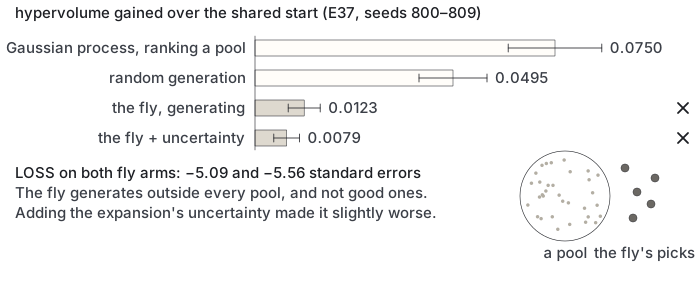
Can the fly generate new alloys that beat ranking a fixed list, on two goals?
No. Ranking a list with a standard statistical model gained 0.0750; the generating fly gained 0.0123, a pre-registered loss.
In the log: Pre-registration: generating crystals against several objectives
falsifiedDate not stated; the file was added to git on 2026-09-12 21:05unclassified0 predictions · 0 result paragraphsPREREGISTER_generative.md lines 1–59
What PREREGISTER:generative did and how it came out, drawn from this record and the files it names (book/assets/diagrams/exp/PREREGISTER-generative.svg).
Pre-registration
Results
No result paragraph for this entry was found in the log.
The full record
PREREGISTER_generative.md · lines 1–59
Pre-registration: generating crystals against several objectives
Fixed before the code runs. Second pre-registration; the first (multi-objective selection)
is recorded as a loss in E35 and is not superseded by this.
E35 compared a Gaussian process and the circuit as selectors from a shared 4,000-point
pool. That removed the only structural difference between them: a Gaussian process cannot
generate. It ranks a list it is given and can never propose a composition outside it. The
circuit walks composition space and proposes as it goes.
The question that matters is therefore not which ranks a list better, but whether a learned
generator can produce crystals meeting several objectives at once - including compositions
no list contained. That is also the question standing behind the generative-flow-network
work: if a learned generator is competitive here, that approach has a basis; if nothing
learned can beat drawing a large pool and ranking it, it does not.
Corrections to the E35 design, all made before seeing any result here
Objectives normalised to [0, 1] over the reference sweep before any hypervolume is
computed. In E35 free energy spanned 250% of its mean and the solid-solution fraction
7%, so the metric was dominated by one and the test was close to single-objective.
Improvement over the shared start is the score, not absolute hypervolume. In E35 the
common 20-point start supplied 94.4% of every method's number.
Matched acquisition. Both the process and the circuit select greedily on their own
predicted scalarisation, with the same ParEGO weights drawn from the same stream. E35
gave the process an uncertainty-aware rule and the circuit pure greed, so part of what
it measured was the acquisition. A separate arm gives the circuit the cluster
expansion's measured uncertainty (E24) as an exploration term; both arms are reported.
Training scales with heads, each head owning its share of the plastic synapses.
Design
Objectives: free energy (minimise) and solid-solution fraction (maximise), from the
128-site environment.
Budget: 60 evaluations, 20 a shared Latin hypercube start.
Seeds: 10, indices 800-809, fixed now.
Score: normalised hypervolume gained over the shared start, reference point the
per-objective minimum of the 4,000-draw sweep, fixed before any run.
Arms:
random generation (draw and evaluate);
Gaussian process + ParEGO, selecting from a 4,000-point pool - its native mode;
the fly, generating by run-and-tumble, two compartment heads, greedy;
the fly, generating, with the expansion's uncertainty as an exploration term.
Also reported, and decided now: how often each arm finds a point that dominates
everything in the 4,000-draw pool. Only a generator can do this; the process cannot by
construction, and its score there is zero by definition rather than by failure.
Verdicts
Win: a fly arm exceeds the process by at least two standard errors on hypervolume
gained.
Draw: within two standard errors.
Loss: the process exceeds both fly arms by at least two standard errors.
Reported whichever occurs. No seed selection, no metric changes, no tuning of either method
on this benchmark. Sparsity stays 0.12 and its outstanding confirmation on an unseen pool
is still outstanding and still reported as such.
Files it names
PREREGISTER_generative.md
Paths in the Forager repository, as the log wrote them.
Related entries
E35 — The multi-objective test: a pre-registered loss, on a benchmark with no power
E24 — The short-range-order correction was regressed on the wrong variable